Tag: airline news

  • Is Southwest Trying to Become a Premium Airline? The Transformation Is Getting Hard to Ignore

    Is Southwest Trying to Become a Premium Airline? The Transformation Is Getting Hard to Ignore

    Is Southwest Trying to Become a Premium Airline? The Transformation Is Getting Hard to Ignore

    For most of my traveling life, Southwest Airlines has existed in its own little corner of the airline world.

    It wasn’t really trying to be Delta.

    It wasn’t really trying to be United.

    And it definitely wasn’t trying to impress you with a fancy airport lounge, assigned seat, or some elaborate premium cabin.

    Southwest was Southwest.

    Two bags flew free. You checked in 24 hours before departure and hoped for a decent boarding position. There were no assigned seats. There was no first class. There were no airport lounges.

    And if you understood the system, there was something refreshingly simple about it.

    Well, that Southwest is changing. Fast.

    And after the airline’s latest announcement, I think we need to start asking a different question:

    Is Southwest trying to become a premium airline?

    I don’t think we’re quite there yet.

    But Southwest is absolutely trying to become an airline that premium travelers take seriously.

    And that’s a much bigger change than simply assigning seats.

    First, Southwest Got Rid of Open Seating

    This was probably the first change that made longtime Southwest flyers realize something major was happening.

    In July 2024, Southwest announced that it would abandon the open-seating system it had used for more than 50 years.

    Assigned seating officially began on January 27, 2026.

    Instead of boarding the airplane and choosing whichever seat is available, Southwest now operates much more like its competitors.

    Passengers can choose among Standard, Preferred, and Extra Legroom seats depending on the fare they purchase, their Rapid Rewards status, or their Southwest credit card benefits.

    Extra Legroom seats offer up to five additional inches of pitch on some aircraft, and Southwest has positioned those seats as its more premium onboard experience.

    No, this isn’t Delta First Class or United Polaris.

    There isn’t even a separate premium cabin.

    But Southwest suddenly has something it never really had before:

    A meaningful way to sell a better seat to a customer willing to spend more money.

    That’s important.

    Then Came the Bags

    This might have been an even bigger change.

    For years, “Bags Fly Free” wasn’t simply a Southwest perk.

    It was part of the airline’s identity.

    In fact, here’s what makes this part of the story fascinating.

    At Southwest’s September 2024 Investor Day, the airline said its own research showed that two free checked bags were so important to customers that eliminating the benefit could actually hurt demand more than the bag fees would generate in revenue.

    In other words:

    Bags Fly Free was staying.

    Less than six months later, Southwest announced it was ending two free checked bags for most passengers.

    Beginning May 28, 2025, most travelers started paying to check bags unless they qualified through their fare, elite status, or a Southwest Rapid Rewards credit card.

    And as of September 2026, most mainland travelers purchasing Basic, Choice, or Choice Preferred fares pay $45 for the first checked bag and $55 for the second.

    That’s a pretty dramatic change for an airline that spent decades marketing itself as the airline that didn’t nickel-and-dime you.

    Southwest Started Flying Red-Eyes

    Here’s another change that doesn’t get as much attention.

    Southwest historically wasn’t really a 24-hour airline.

    That started changing in February 2025 when Southwest launched its first scheduled overnight red-eye flights.

    That might sound like a small scheduling change, but operationally it matters.

    Red-eyes allow Southwest to use its airplanes more efficiently, connect more markets, and behave more like a traditional network carrier.

    An airplane sitting on the ground overnight isn’t making any money.

    An airplane flying passengers across the country overnight is.

    That’s Airline Economics 101.

    Southwest Started Looking Beyond Its Own Network

    This is another major departure from the Southwest many of us grew up with.

    Southwest traditionally operated as a very self-contained airline.

    You flew Southwest.

    Then you got off the Southwest airplane.

    That was pretty much it.

    Now Southwest is developing partnerships with international airlines that can connect its domestic network with destinations around the world.

    It started with Icelandair.

    Today, Southwest’s partner lineup has expanded dramatically and includes airlines such as ANA, EVA Air, Singapore Airlines, Turkish Airlines, TAP Air Portugal, Condor, China Airlines, Philippine Airlines, Air Premia, LOT Polish Airlines, and Icelandair.

    Suddenly, Southwest isn’t thinking only about getting someone from Baltimore to Orlando.

    It is participating in a much larger global travel ecosystem.

    That starts sounding a lot more like a network airline.

    Then Came Free Wi-Fi

    In October 2025, Southwest began offering free inflight Wi-Fi to Rapid Rewards members through a partnership with T-Mobile.

    And importantly, you don’t have to be a T-Mobile customer.

    You simply need a Rapid Rewards account.

    For someone like me who spends a lot of time on airplanes and often works while traveling, Wi-Fi isn’t really a luxury anymore.

    It’s part of the product.

    Delta understood that.

    Other airlines are moving in that direction.

    Southwest clearly understands it too.

    Southwest Is Selling Vacations Now, Too

    In August 2025, Southwest launched Getaways by Southwest, its own vacation-packaging business.

    Customers can package airfare with hotels, rental cars, and other travel components directly through Southwest.

    Again, this isn’t necessarily something that makes an airline “premium.”

    But it shows something bigger happening.

    Southwest wants a larger piece of the travel relationship.

    It doesn’t just want your airline ticket.

    It wants your loyalty.

    It wants your credit card spending.

    It wants your vacation booking.

    And now it wants to be part of your airport experience before you ever get on the airplane.

    Which brings us to the announcement that really caught my attention.

    Southwest Is Getting Airport Lounges

    Yes.

    Southwest Airlines lounges.

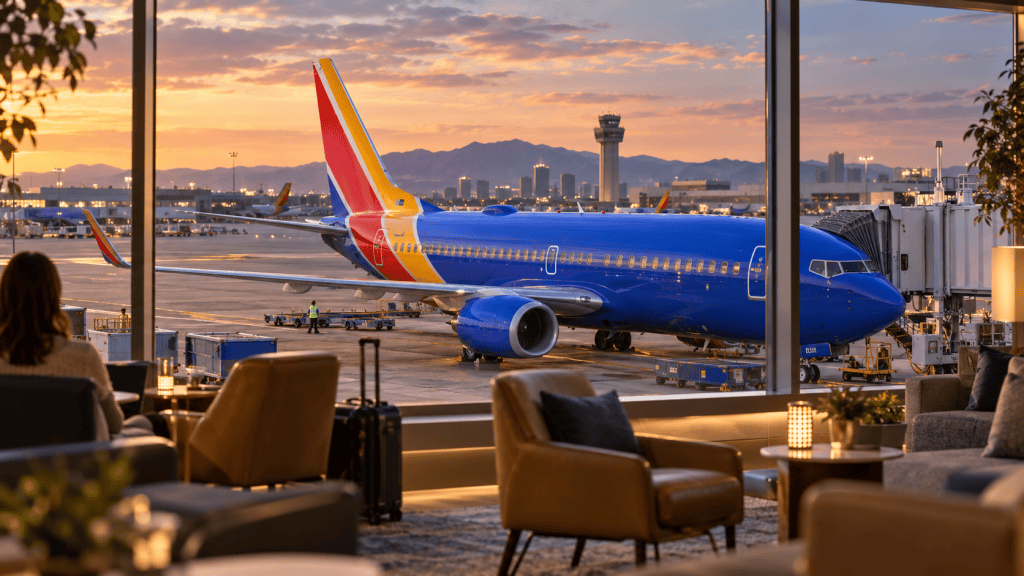
    Beginning in late 2027, Southwest plans to open its first airport lounges in partnership with Chase.

    The first four are planned for Austin, Baltimore, Honolulu, and Nashville.

    And Southwest says at least seven additional lounges are planned over the following years.

    The lounges are expected to offer many of the things we’ve come to expect from premium airport lounges, including comfortable spaces, food and beverages, places to work, charging, and locally inspired design.

    Southwest is also planning a new premium Rapid Rewards credit card from Chase in 2027 that will include access to the lounge network.

    That is a very different Southwest Airlines.

    Is Southwest Really Becoming a Premium Carrier?

    This is where I think we need to be careful.

    Southwest isn’t suddenly Delta or United.

    There still isn’t a traditional first-class cabin.

    There isn’t a lie-flat business-class seat.

    There isn’t a huge international long-haul network operated by Southwest aircraft.

    The airline still flies an all-Boeing 737 fleet, and even its premium seating today is essentially a better economy seat with additional legroom.

    So calling Southwest a premium airline today is probably going too far.

    But saying Southwest wants premium customers?

    I think that’s undeniable.

    Assigned seats.

    Extra-legroom seating.

    Premium fare bundles.

    Red-eye flights.

    International airline partnerships.

    Free Wi-Fi.

    Vacation packages.

    A more sophisticated loyalty and credit-card strategy.

    And now airport lounges.

    Those things aren’t happening accidentally.

    Southwest is moving directly toward the customers that Delta, United, and American have spent years fighting over.

    And This Is Where It Gets Interesting for Me

    When I think about the major U.S. carriers from my own perspective as a frequent traveler, I tend to put Delta and United in their own battle at the top.

    They each do certain things better than the other.

    American, for me, has always felt like a pretty distant third.

    That’s my personal travel perspective, not some scientific airline ranking.

    And Southwest?

    I’ve never really included Southwest in that conversation.

    Not because Southwest isn’t a huge airline.

    It is.

    But its product was fundamentally different.

    If I wanted lounges, premium seating, a more traditional frequent-flyer experience, and the kind of network that works for someone who travels frequently, Southwest wasn’t really the airline I was comparing with Delta or United.

    That is starting to change.

    I’m Watching Southwest Differently Now

    I’ve mentioned before that while I’m certainly not ready to say I’m “done” with Delta, United has been getting more and more of my attention.

    I like a lot of what United is doing.

    Their network works well for me.

    Their premium product is compelling.

    Their lounges and airport experience are improving.

    And they seem very focused on competing for frequent travelers.

    But now I’m looking at Southwest and thinking:

    Maybe I need to give these guys another look too.

    Especially as the next pieces of this transformation arrive.

    If Southwest eventually adds a true first-class product, continues expanding international partnerships, builds a legitimate lounge network, and improves the onboard experience while maintaining some of that Southwest personality people genuinely like, they could become a very interesting competitor.

    And Reuters recently reported that Southwest CEO Bob Jordan has even suggested longer-haul international flying and true first-class seating could eventually be possibilities.

    Now that would really change the conversation.

    But Southwest Has to Be Careful

    There is one danger in all of this.

    Southwest became successful because it wasn’t Delta, United, or American.

    People understood the deal.

    The product was simple.

    The airline had personality.

    Two bags flew free.

    There weren’t 15 different ways to pay extra for something.

    As Southwest becomes more like everybody else, it has to make sure it doesn’t simply become everybody else.

    Because if Southwest charges bag fees, charges for better seats, sells premium credit cards, assigns seats, and starts building lounges, travelers are eventually going to compare Southwest directly with Delta and United.

    And that means the product has to hold up.

    That’s the tradeoff.

    Southwest can absolutely move upstream and attract more premium travelers.

    But once you enter that arena, customers start expecting a premium experience.

    My Two Cents

    I think this might be one of the most interesting airline transformations happening in the United States right now.

    Southwest isn’t just tweaking a few policies.

    It is systematically changing almost every element that once made Southwest different from the legacy airlines.

    Some longtime Southwest customers probably aren’t going to like that.

    I understand why.

    If you loved Southwest because of open seating and two free checked bags, you’re watching the airline eliminate some of the exact reasons you chose it.

    But from the perspective of someone who flies frequently and values the entire travel experience, I’m intrigued.

    Give me a good assigned seat.

    Give me reliable Wi-Fi.

    Give me extra legroom.

    Give me a lounge where I can work before the flight.

    Give me meaningful loyalty benefits.

    Give me useful partnerships when I travel internationally.

    And suddenly I’m paying attention.

    I’m not ready to put Southwest alongside Delta and United yet.

    But for the first time in a long time, I think Southwest actually wants to get into that conversation.

    And by 2027, we may be looking at a very different airline than the Southwest we all thought we knew.

    Travel smart,
    Tommy Pags

  • American Airlines Is Bringing Seatback Screens Back. Good. They Never Should Have Left.

    American Airlines Is Bringing Seatback Screens Back. Good. They Never Should Have Left.

    American Airlines Is Bringing Seatback Screens Back. Good. They Never Should Have Left.

    American Airlines just announced that seatback entertainment screens are coming back to its narrowbody fleet.

    My first reaction?

    Good.

    My second reaction?

    Why did they take them out in the first place?

    American is reversing a strategy that dates back to 2017, when the airline decided its new Boeing 737 MAX aircraft would not have seatback entertainment screens. At the time, American’s argument was that more than 90% of its passengers already brought a phone, tablet or laptop onboard, so it made more sense to invest in streaming entertainment and connectivity than screens built into the seats.

    On a PowerPoint presentation in a conference room somewhere, I can see how that probably made perfect sense.

    In the real world?

    I think it completely misunderstood the customer.

    Just Because I Have a Screen Doesn’t Mean I Want to Use It

    I travel with an iPhone and an iPad on virtually every flight I take.

    And ironically, I am probably not American’s best argument for bringing the screens back because I usually watch something on my iPad anyway.

    But that’s my choice.

    There is a big difference between saying, “Most passengers carry a device,” and saying, “Most passengers would prefer to use that device instead of a seatback entertainment system.”

    Those are two entirely different things.

    Your phone might be charging. You might want to text someone using the Wi-Fi. You might want to check your email while watching a movie. You might have a child with you who doesn’t have a device. Maybe you didn’t download anything before the flight. Maybe your battery is dying.

    Or maybe you simply don’t want to hold your phone or balance an iPad somewhere for three hours.

    Having a phone in your pocket doesn’t make the screen in front of you unnecessary.

    Sometimes Companies Stop Watching Their Customers

    I’ve worked in enough companies, departments and leadership teams over the years to see the human side of how decisions like this happen.

    Consumers normally see the finished decision.

    They don’t see the meetings.

    They don’t see the personalities.

    They don’t see the person who walks into a room convinced that he or she has the answer, or the people around the table who might disagree but eventually stop arguing.

    Good leadership, in my experience, isn’t simply walking into the room with the best idea.

    It’s bringing together people with different experiences, listening to them, challenging assumptions and then making the best decision possible for the customer and the business.

    Sometimes companies do that extraordinarily well.

    Sometimes somebody falls in love with an idea.

    And once that happens, an organization can spend years defending something customers never really wanted.

    I can’t tell you exactly what happened inside American Airlines in 2017, and I’m certainly not suggesting one person made this decision alone.

    But from the outside, this has always looked like one of those decisions where the spreadsheet won over the customer.

    Here’s the Research I Would Have Done

    This part isn’t complicated.

    Get on an airplane.

    Sit in economy.

    Look around.

    I do it every week.

    When I’m on an aircraft equipped with seatback entertainment, plenty of those screens are being used. My completely unscientific observation from flying is that on many flights it looks like more than half the cabin has something playing.

    Movies.

    TV shows.

    The moving map.

    Kids programming.

    Sometimes people aren’t even actively watching. The map is simply running while they’re doing something else.

    That’s customer behavior happening right in front of you.

    And here’s the important part: those passengers often have phones sitting next to them too.

    The seatback screen didn’t replace their device.

    It complemented it.

    That distinction seems obvious today, but apparently it wasn’t obvious enough in 2017.

    American Is Now Making a Very Big U-Turn

    This isn’t American putting screens on a handful of new airplanes.

    The airline says it plans to install seatback entertainment at every seat across its narrowbody fleet, including both new aircraft and retrofitted planes. New aircraft deliveries with screens are expected to begin in 2028, with the broader rollout continuing into the early part of the next decade.

    And these aren’t going to be the clunky airline screens many of us remember from years ago.

    American says the new system will include:

    • 4K displays
    • Bluetooth connectivity for wireless headphones
    • USB-C fast charging
    • Personalized entertainment
    • Enhanced flight maps
    • Movies, television, music and games
    • Integration alongside American’s upcoming Starlink Wi-Fi

    American is also increasing premium seating on its narrowbody fleet from roughly 25% of seats today to about 40% in the coming years.

    So clearly this is part of something bigger.

    American is trying to make its domestic product feel more premium and compete more directly with Delta and United.

    That makes sense.

    This Reminds Me of the CarPlay Debate

    There’s a similar corporate mindset happening in the automotive industry.

    Some automakers have moved away from Apple CarPlay and Android Auto in favor of their own integrated systems.

    Again, maybe there is a terrific business case for doing that.

    But there’s a simple customer question that has to come first:

    What does the customer actually want?

    People already live inside the ecosystems on their phones.

    They have their apps.

    Their music.

    Their messages.

    Their navigation preferences.

    Their contacts.

    Their podcasts.

    When someone buys a $50,000 vehicle, telling them they can’t use the interface they already prefer because the manufacturer has decided something else is better can feel incredibly tone deaf.

    The airline screen decision strikes me the same way.

    Technology should give customers more choices, not take choices away from them.

    Want to watch your iPad?

    Great.

    Want to stream American’s entertainment to your phone?

    Great.

    Want to put your phone down, connect your AirPods to the screen in front of you and watch a movie?

    You should be able to do that too.

    But There’s Still Something More Important Than the Screen

    I give American credit for reversing course.

    Companies don’t always do that.

    Sometimes the hardest words for a large organization to say are essentially, “We got this one wrong.”

    And American is putting real money behind the reversal.

    But if I’m American Airlines and I’m making a list of what passengers really want from me, a beautiful 4K entertainment system isn’t at the top.

    Get me where I’m going.

    Get me there safely.

    Get me there reasonably close to the time you told me I would arrive.

    Handle disruptions well when something goes wrong.

    Treat customers like human beings when their travel plans fall apart.

    Then we can talk about the television.

    The entertainment system absolutely affects the experience, particularly when American wants to position itself as a premium full-service airline.

    But reliability is still the product.

    Everything else is an amenity.

    My Take

    I think American made the wrong call in 2017.

    Not because phones and tablets weren’t becoming more important. American was absolutely right about that.

    The mistake was assuming one technology had to replace the other.

    Nearly a decade later, American seems to have reached the same conclusion.

    Your phone isn’t replacing the airplane screen.

    Your airplane screen isn’t replacing your phone.

    They can coexist.

    And sometimes the best market research isn’t another survey, consulting report or executive presentation.

    Sometimes you just need to sit in 28C, look around the cabin and watch what your customers are actually doing.

    American finally appears to have looked around.

    Better late than never.

    Travel Smart,

    Tommy Pags

  • AI Should Make Flying Better, Not Figure Out How Much It Can Squeeze Out of You

    AI Should Make Flying Better, Not Figure Out How Much It Can Squeeze Out of You

    AI Should Make Flying Better, Not Figure Out How Much It Can Squeeze Out of You

    I love technology.

    I love what it can do for travelers. I love when an airline uses technology to predict a missed connection, get a bag where it belongs, improve maintenance, reduce delays, communicate better during an irregular operation or help an employee solve a problem faster.

    And I am genuinely excited about what artificial intelligence could do for air travel.

    But there is a line.

    Technology should help companies serve customers better. It should not help companies figure out exactly how much they can squeeze out of each individual customer.

    That is why the growing debate over what is being called “surveillance pricing” deserves the attention it is getting.

    Congress Is Asking Questions

    On August 12, Rep. Frank Pallone, the ranking Democrat on the House Energy and Commerce Committee, announced that he had sent inquiries to eight major U.S. airlines: Alaska, American, Delta, Frontier, Hawaiian, JetBlue, Southwest and United.

    He wants the airlines to explain whether artificial intelligence and consumer data play a role in determining the prices travelers see.

    The airlines have been asked to respond by August 25.

    And Congress isn’t asking only whether airlines use AI.

    The questions get much more specific.

    Pallone’s letter asks about information including age, employment, income, spending history, loyalty-program participation, browsing behavior, location, IP address and device information. In other words, lawmakers want to know whether the airline is pricing the flight, or pricing the person shopping for the flight.

    That difference matters.

    Dynamic Pricing Is Not the Problem

    I want to be careful here because airline tickets have never worked like a gallon of milk sitting on a grocery-store shelf.

    Airlines have used dynamic pricing and revenue management for decades.

    A flight that costs $249 today might cost $329 tomorrow. As seats disappear, demand increases, departure gets closer or competitors change their fares, prices move.

    I understand that.

    I may not always like it, but there is a legitimate business reason behind it.

    What I have a serious problem with is something entirely different.

    Imagine you and I are sitting next to each other.

    Same flight.

    Same date.

    Same cabin.

    Same seat availability.

    Same moment.

    But an algorithm believes I travel frequently for business, knows I usually buy at the last minute, knows my approximate income, sees that I have searched this route four times today and concludes that I am probably desperate to go.

    So my ticket is $489.

    You get $379.

    Not because the flight changed.

    Because the computer decided I would tolerate paying more.

    That is not ordinary dynamic pricing.

    That is the issue Congress is investigating.

    The Federal Trade Commission has already found that surveillance-pricing technology in the broader economy can use remarkably granular information, including location, demographics, browsing activity, shopping history and even how consumers behave on a webpage, to help tailor prices and offers.

    And I think consumers have every reason to be concerned about that.

    Then Delta Said Something That Got Everyone’s Attention

    This controversy didn’t come from nowhere.

    In 2025, then-Delta President Glen Hauenstein discussed the airline’s work with AI pricing company Fetcherr. Delta said the technology was being used across about 3% of its domestic network at the time, with plans to expand it significantly.

    But it was an earlier description of Delta’s long-term pricing vision that really set off alarm bells.

    Hauenstein talked about eventually having a price available for a particular flight, at a particular time, “to you, the individual.”

    He also described the technology as part of a major reengineering of how Delta prices its product.

    Now, to be fair to Delta, the company has subsequently been very clear in its denial.

    Delta says it has never used, is not testing and does not plan to use personal information to create individualized airline fares. It says Fetcherr works from aggregated market and demand information, not individual customer data.

    That matters, and Delta’s denial deserves to be included in this conversation.

    But I also understand why lawmakers heard those earlier comments and started asking questions.

    If you tell Wall Street that technology is going to dramatically improve revenue and someday help create an offer for “you, the individual,” consumers are naturally going to ask:

    Exactly what does the computer know about me when it determines that price?

    That is a fair question.

    And Then Came JetBlue

    JetBlue has an entirely separate controversy.

    In April, a traveler complained publicly after a fare reportedly increased $230 while he was trying to book travel for a funeral.

    JetBlue’s social-media account responded by suggesting that he clear his cache and cookies or try an incognito browser.

    You can imagine what happened next.

    The Internet exploded.

    JetBlue later said the response was simply a mistake by a customer-service employee and that clearing cookies would not have changed the available airfare. JetBlue says it does not use personal information, browsing history or AI to set individualized ticket prices.

    But the exchange helped trigger additional scrutiny and a proposed federal class-action lawsuit alleging that JetBlue uses consumer information in what the complaint calls “dynamic surveillance pricing.”

    Those are allegations, not proven facts, and JetBlue denies them.

    Still, the story demonstrates exactly why airlines need to be incredibly transparent about this.

    Technology Without a Conscience Is a Dangerous Business Model

    Here is where I come down on it.

    I don’t have a problem with airlines making money.

    I don’t have a problem with airlines using sophisticated revenue-management systems.

    I don’t even have a problem with AI helping an airline determine that demand for Allentown to Orlando next Friday is stronger than expected and that the market can support a higher fare.

    That’s business.

    But the price should be based on the product and the market, not on an algorithm digging through my digital life trying to determine my breaking point.

    Because think about where that eventually leads.

    The computer knows you’re searching at 2:00 in the morning.

    It knows you’ve looked at the same flight eight times.

    It knows you’re searching one-way.

    It knows where you are.

    It potentially knows what you’ve bought before.

    Maybe someday it can infer that you’re dealing with an emergency.

    And suddenly the question isn’t, “What is this airline seat worth?”

    The question becomes:

    “How desperate is this person, and how much can we get out of him?”

    That is where technology stops serving the customer and starts exploiting the customer.

    I call that cheating.

    Trust Takes Years to Build and Seconds to Destroy

    Companies sometimes underestimate how quickly consumers figure these things out.

    Twenty years ago, maybe a pricing experiment could remain buried inside a complicated computer system.

    Not anymore.

    Someone posts a screenshot.

    Someone else tries the exact same search.

    Reddit starts comparing prices.

    TikTok picks it up.

    News organizations start calling.

    Congress starts asking questions.

    And suddenly something that looked like a brilliant revenue opportunity in a conference room becomes a full-blown brand problem.

    The worst part is that by the time senior leadership realizes how angry customers are, the damage may already be done.

    Trust is incredibly valuable.

    Customers want to believe that the company they are doing business with is dealing with them fairly.

    They understand sales. They understand promotions. They understand prices changing because supply and demand change.

    What they don’t want is the feeling that a company is secretly sizing them up before deciding how hard it can hit their wallet.

    There Is a Better Way to Use AI

    Interestingly, American Airlines CEO Robert Isom addressed this controversy in 2025 and described a very different approach.

    He said American wanted to use AI to improve things like operations, how products are presented and employee efficiency, and specifically rejected using the technology for “bait-and-switch” or tricking customers.

    That’s the direction I hope the entire industry takes.

    Use AI to predict mechanical problems before they cancel my flight.

    Use it to automatically protect my connection when my inbound aircraft is running late.

    Use it to make baggage tracking nearly perfect.

    Use it to help gate agents.

    Use it to improve scheduling.

    Use it to reduce call-center wait times.

    Use it to identify operational problems before they become problems.

    Use it to make flying safer, easier and less stressful.

    There are a thousand ways artificial intelligence could make air travel better.

    We don’t need the thousand-and-first use to be turning travelers upside down and shaking them to see what falls out of their pockets.

    That isn’t innovation.

    It’s just an incredibly sophisticated way to nickel-and-dime people.

    And if the airline industry ever crosses that line, I suspect travelers will figure it out much faster than the airlines think.

    Pags Take

    I am extremely optimistic about AI.

    But innovation without ethics isn’t progress.

    Airlines should absolutely use artificial intelligence to understand their business better. They should use it to improve the customer experience, support employees, operate more efficiently and make aviation safer.

    What they should never do is use what technology knows about me to figure out how much more they can make me pay.

    The airfare can change because the market changed.

    It should never change because the airline thinks it has figured me out.

    That is a line worth protecting.

    And Congress is right to ask whether anyone has crossed it.

    Travel smart,
    Tommy Pags