
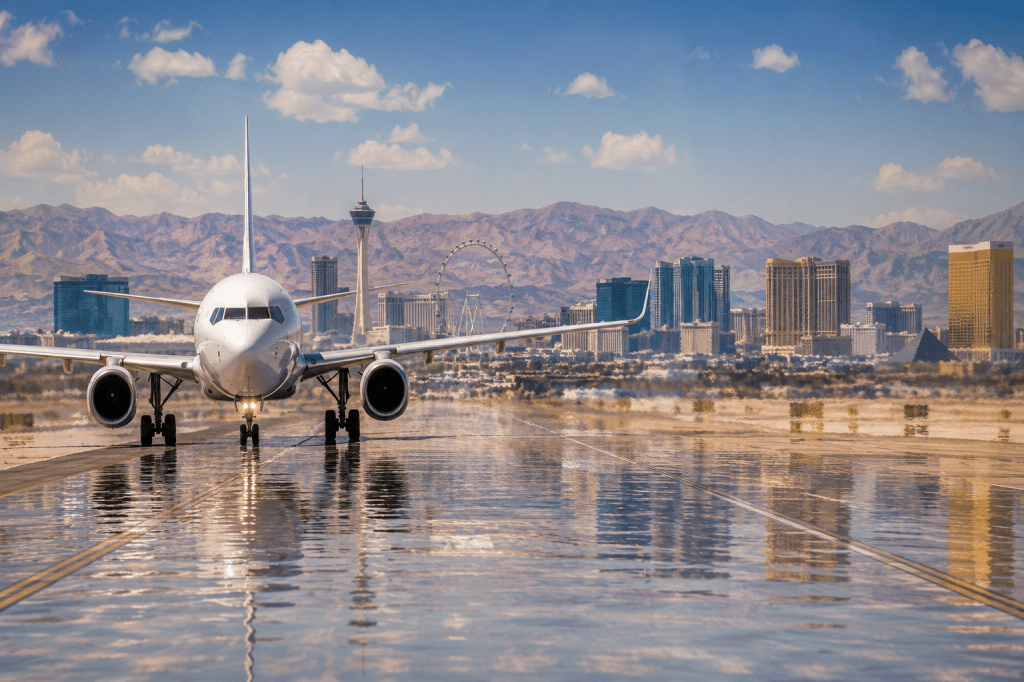
Why It’s “Too Hot to Fly” in Las Vegas, and What Smart Travelers Should Do About It
If you’ve ever heard someone say, “It’s too hot for planes to fly,” it sounds ridiculous.
After all, airplanes fly through deserts every day.
But this week in Las Vegas, it became reality.
As temperatures climbed well above 110°F, several flights at Harry Reid International Airport were delayed, and in one widely reported case, passengers were actually asked to volunteer to get off the airplane because it was too heavy to safely depart in the extreme heat.
I’m actually in Las Vegas this week for the Summer Las Vegas Market, and let me tell you, it’s brutally hot outside. Walking between buildings feels like opening an oven door.
So what’s really happening?
The Science Is Actually Pretty Simple
Airplanes fly because their wings generate lift.
The hotter the air gets, the less dense it becomes. Think of it as the air becoming “thinner.” Thin air doesn’t give the wings as much to push against, and jet engines also produce slightly less thrust. The result is that airplanes need more runway and more speed before they can safely lift off.
If the aircraft is carrying too much weight, there may not be enough runway available to safely accelerate and climb.
That’s when airlines have a few options:
- Delay the flight until temperatures cool.
- Offload cargo or baggage.
- Reduce fuel and make a fuel stop later.
- Ask passengers to volunteer to take a later flight.
Safety always wins.
Las Vegas Makes It Even Harder
Las Vegas is already challenging because of its desert climate.
Now combine:
- Temperatures over 110°F.
- A busy airport with constant departures.
- Aircraft loaded with passengers, luggage, and fuel.
It’s the perfect recipe for weight restrictions. Fortunately, Harry Reid has one of the longest runways in the country, which helps, but even that has limits during extreme heat.
Here’s the Real Travel Lesson
The weather itself isn’t the story.
Preparation is.
One thing I’ve learned after hundreds of flights is that the travelers who recover the fastest are usually the ones who knew there was a problem before everyone else.
Don’t just check the weather where you’re leaving.
Check:
- Your departure city.
- Your connection city.
- Your destination.
A thunderstorm in Denver can affect your flight from Philadelphia to Salt Lake City. Extreme heat in Las Vegas can impact departures all afternoon.
Weather anywhere in your aircraft’s journey can become your problem.
The Biggest Mistake Travelers Make
When a flight gets canceled, something interesting happens.
Every single person on your airplane is suddenly trying to get to the exact same destination you are.
If 180 passengers are stranded, they’re all competing for the same handful of available seats.
That’s why speed matters.
If you’ve already been watching your flight, already know your alternate flights, and already have the airline app open, you can often rebook before half the cabin has even stood up.
I’ve seen travelers spend twenty minutes waiting in line at the gate while someone sitting in Row 22 has already secured the last available seat on the next departure using the airline’s app.
My Advice
Weather is one of the few things airlines can’t control.
What you can control is your awareness.
Know what’s happening before you leave for the airport.
Watch your inbound aircraft.
Know your backup flights.
If things start going sideways, act quickly.
In travel, information is often your biggest advantage.
Travel Smart,
Tommy Pags
 Pags on the Go