Tag: Frequent Flyer

  • Chase Is Tightening Sapphire Lounge Access, and I Think It Is the Right Move

    Chase Is Tightening Sapphire Lounge Access, and I Think It Is the Right Move

    Chase Is Tightening Sapphire Lounge Access, and I Think It Is the Right Move

    Beginning August 15, 2026, Chase is changing who can enter its Sapphire Lounges and giving some of its own cardholders more time inside.

    The biggest change is that Chase Sapphire Lounges will no longer participate in the Priority Pass or LoungeKey networks. Until now, travelers who received Priority Pass through another credit card could visit a Sapphire Lounge once per calendar year at no charge. Additional visits, or certain guest visits, were available for $75.

    That option is going away.

    After August 15, complimentary access will be reserved for customers with an eligible Chase-issued card, including the Chase Sapphire Reserve, Sapphire Reserve for Business, J.P. Morgan Reserve and Ritz-Carlton Credit Card. Eligible cardholders will continue to receive unlimited Sapphire Lounge visits and may bring up to two complimentary guests. Additional guests will continue to cost $27 each.

    At the same time, Chase is adding a useful benefit for its customers. Cardholders traveling on a same-day connecting itinerary will be allowed to enter a Sapphire Lounge up to five hours before the departure of their connecting flight. That is an increase from the current three-hour window.

    The five-hour rule does not apply when you are starting your trip. Travelers originating at an airport, including those taking a nonstop flight, will still be limited to entering three hours before departure.

    Airport Lounges Are More Than a Travel Perk

    I understand why some travelers will be disappointed by the decision. Losing access to a good lounge is never going to feel like an improvement, particularly for someone who has been saving that one annual Priority Pass visit.

    But as someone who spends a lot of time in airports, I think Chase is making the right move.

    There is a real difference between the way a frequent business traveler uses an airport and the way an occasional vacation traveler may experience it. For the casual traveler, getting to the airport can be part of the excitement of the trip.

    For someone who travels regularly, the airport is usually not entertainment. It is another workplace, a place to answer emails, return phone calls, prepare for a meeting or simply decompress before getting on another airplane.

    That is why a good lounge matters.

    It provides a quieter environment, reliable Wi-Fi, room to work, something to eat and, depending on the day, perhaps a cocktail. During a delay or a long connection, the lounge can become the difference between getting meaningful work done and spending several hours searching for an outlet near a crowded gate.

    The complimentary food and drinks are certainly valuable, but the real benefit is having a functional place to spend your time.

    We Have Seen This Crowding Problem Before

    There was a period following the pandemic when Delta Sky Clubs became incredibly busy. At some airports, lines formed outside the clubs because so many people had access that the passengers who depended on them most frequently could not get inside.

    I remember seeing those lines and wondering what good lounge access was if you had to stand in the terminal waiting for permission to enter.

    Delta eventually tightened several of its access policies. Today, many eligible premium credit card customers have a limited number of Sky Club visits each year unless they meet a substantial annual spending requirement. Delta also generally limits entry to three hours before departure, although connecting customers may enter during their layovers.

    Those decisions were unpopular with some customers, but something had to change. A lounge cannot provide a calmer, more premium experience when it is just as crowded as the terminal outside.

    Chase now appears to be confronting the same issue.

    As the Sapphire Lounge network has expanded and more travelers have discovered how good the lounges are, demand has increased. Chase currently lists Sapphire Lounges in Boston, Las Vegas, New York-JFK, New York-LaGuardia, Philadelphia, Phoenix, San Diego and Dallas-Fort Worth, with a Los Angeles location coming soon.

    These are not basic waiting rooms with a bowl of pretzels and a soft-drink machine. Chase has invested in locally inspired food, made-to-order selections, signature cocktails, comfortable workspaces and, at some locations, wellness services and other premium amenities.

    I have had the opportunity to visit a Sapphire Lounge, and it was impressive. The lounge looked great, the food was excellent and the experience felt noticeably more elevated than sitting in the terminal. In fact, it deserves a complete review of its own.

    Chase Is Prioritizing Chase Customers

    The old Priority Pass policy was an effective way to introduce travelers to the Sapphire Lounge experience. Someone with Priority Pass from American Express, Capital One or another provider could visit once a year, see what Chase was offering and potentially consider becoming a Chase Sapphire Reserve customer.

    But that introductory period appears to be ending.

    Chase has built a recognizable lounge network, and now it wants to make sure that the customers carrying its premium cards can use it. That does not strike me as unreasonable.

    These lounges are part of the value Chase is selling to Sapphire Reserve customers. If the lounges become so crowded that those customers face long waits or cannot find a place to sit, Chase is weakening one of its own most visible benefits.

    The company is not eliminating lounge access for Sapphire Reserve customers. Eligible Chase cardholders will retain their Sapphire Lounge access, guest privileges and Priority Pass Select membership for participating lounges elsewhere in the Priority Pass network. Chase is simply removing the ability to enter its branded Sapphire Lounges through a Priority Pass or LoungeKey membership issued outside the eligible Chase card portfolio.

    That distinction is important.

    The Five-Hour Connection Window Makes Sense

    The other side of the announcement is particularly valuable for frequent travelers.

    A three-hour entry limit may be reasonable when someone arrives extremely early for the first flight of the day. A connection is different. Travelers do not always choose the length of their layovers, and delays, schedule changes and limited flight availability can create connections lasting four or five hours.

    Allowing eligible Chase cardholders to enter during a connection up to five hours before the next flight shows that Chase understands how its customers actually travel.

    A long connection is exactly when a lounge is most useful. You can have a meal, charge your devices, work for a few hours or simply relax without sitting at the gate for half a day.

    It is also worth noting that Delta currently allows eligible connecting passengers to access a Sky Club during a layover without applying its normal three-hour predeparture restriction. Chase’s new five-hour policy is more clearly defined, but both companies recognize that connections need to be treated differently from the beginning of a trip.

    Lounges Are Returning to Their Original Purpose

    Airport lounges have become a major part of the competition between airlines and premium credit card companies. Delta is investing heavily in its Sky Clubs and Delta One Lounges. American Express has its Centurion Lounges. Capital One continues developing its own lounge network, and Chase has quickly created a Sapphire Lounge product capable of competing with all of them.

    Some companies will offer better food. Others will have larger spaces, better bars, showers, wellness rooms or more impressive designs. Individual locations will always vary.

    But underneath all those premium touches, the basic purpose remains the same.

    A lounge should be a comfortable place to eat, relax and get some work done while waiting for a flight. It should also provide somewhere dependable to go when a delay turns a short airport visit into a much longer one.

    For lounges to serve that purpose, access has to be managed.

    Chase’s decision will disappoint travelers who were using a non-Chase Priority Pass membership for their annual Sapphire Lounge visit. That reaction is understandable. But for Sapphire Reserve customers, the change should help preserve the experience they are paying to receive.

    In my view, that is not Chase taking something away from its customers. It is Chase taking better control of a product it created for them.

    The airport lounge may never be the most exciting part of a trip, but for frequent travelers, it can be one of the most useful.

    Travel smart,

    Tommy Pags.

  • Basic Economy Just Got Even Worse for Frequent Flyers: Here’s Why I’m Avoiding It

    Basic Economy Just Got Even Worse for Frequent Flyers: Here’s Why I’m Avoiding It

    Basic Economy Just Got Even Worse for Frequent Flyers: Here’s Why I’m Avoiding It


    Basic Economy Isn’t the Bargain It Used to Be

    There was a time when booking Basic Economy came with a few compromises. You might lose seat selection or board a little later, but if you were a loyal customer with airline status, you still earned something for your loyalty.

    Those days are over.

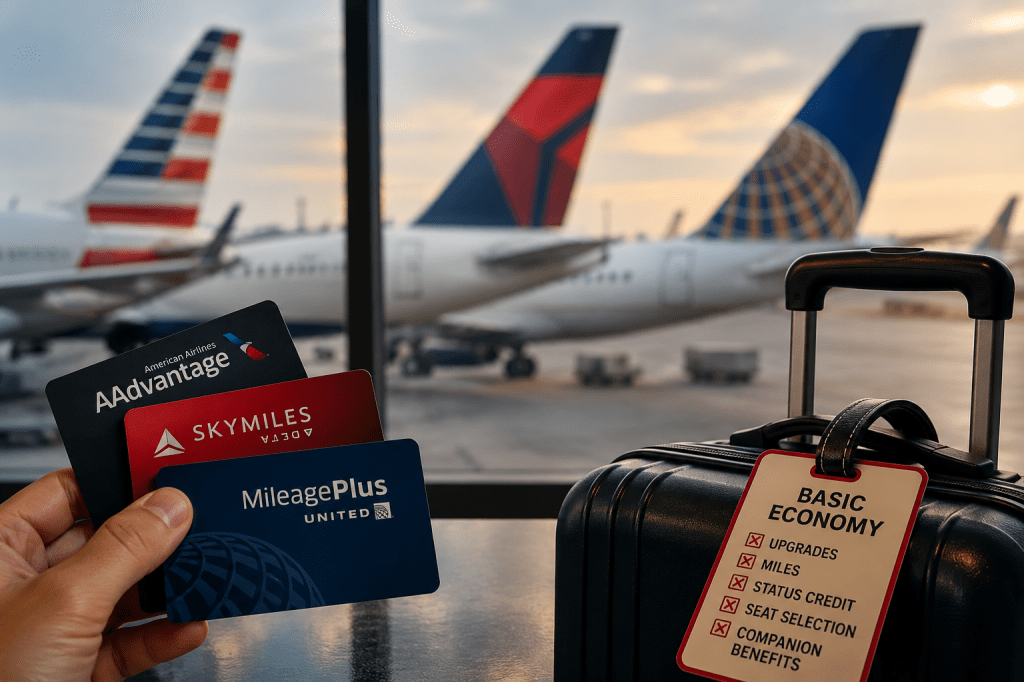
    American Airlines, Delta Air Lines, and United Airlines have all made it clear: if you buy Basic Economy, don’t expect your elite status to help you much anymore.

    For travelers chasing status, this isn’t just another policy change. It completely changes the value equation.


    The New Reality

    The biggest change is simple.

    If you’re flying Basic Economy:

    • No redeemable miles on many qualifying fares.
    • No progress toward elite status.
    • No complimentary upgrades.
    • Reduced or eliminated elite benefits.
    • In many cases, fewer opportunities to use the perks you’ve spent years earning.

    American officially eliminated mileage earning on Basic Economy tickets in late 2025. Delta and United have continued moving in the same direction, making their lowest fares little more than transportation from Point A to Point B.

    The message from the airlines couldn’t be clearer:

    Want loyalty benefits? Buy a more expensive ticket.


    This Hits Frequent Travelers the Hardest

    As someone who flies almost every week, this caught my attention.

    For years I was a Delta loyalist. If you’ve been following Pags on the Go, you already know my relationship with Delta has become… complicated.

    Lately I’ve seen Delta pricing become dramatically more expensive than United and American on many of my regular routes. Sometimes we’re talking hundreds of dollars more for essentially the same trip.

    Now they’re asking frequent travelers to pay even more just to preserve the benefits we’ve already worked hard to earn.

    That doesn’t sit particularly well with me.


    Loyalty Programs Are Becoming Revenue Programs

    This is the part that I think many travelers are missing.

    Airline loyalty programs used to reward how often you flew.

    Today they reward how much money you spend.

    That’s a huge philosophical shift.

    The airlines have figured out something simple:

    Business travelers, corporate travelers, and premium leisure travelers are willing to pay more.

    Instead of rewarding frequency, they’re rewarding revenue.

    From a business standpoint, I understand it.

    From a customer standpoint, it certainly feels different than it did even five years ago.


    Should You Ever Book Basic Economy?

    For many travelers, the answer is actually…

    Yes.

    If you fly once or twice a year…

    If you don’t care about airline status…

    If you’re simply looking for the cheapest possible fare…

    Basic Economy may still make perfect sense.

    But if you’re chasing elite status, trying to earn upgrades, or hoping to keep your Gold, Platinum, Executive Platinum, Premier, Medallion, or similar level…

    Basic Economy has become a trap.

    The savings on the ticket can easily cost you far more in lost benefits later.


    My Rule of Thumb

    Here’s how I look at it.

    If Main Cabin is only $30 to $75 more than Basic Economy, I almost always choose Main Cabin.

    Why?

    Because I want:

    • Seat selection.
    • Flexibility if plans change.
    • Miles earned.
    • Credit toward future status.
    • Better upgrade opportunities.
    • The ability to actually use the loyalty program I’m investing in.

    Those benefits usually outweigh the small upfront savings.


    One More Thing to Watch

    One detail that deserves attention is codeshare flights.

    If you’re booking through one airline but flying on another, Basic Economy restrictions don’t always match what you expect. The operating airline’s rules often determine which benefits you actually receive.

    Before clicking “Purchase,” take a minute to verify exactly what you’re buying.

    That five-minute check could save you a lot of frustration at the airport.


    Final Thoughts

    I’ve said it before on this site, and I think it applies here too:

    Airline loyalty is becoming a two-way negotiation.

    The airlines expect us to stay loyal.

    But they also have to earn ours.

    When ticket prices climb, benefits shrink, and elite status becomes harder to maintain, travelers should feel comfortable shopping around. Blind loyalty doesn’t make much sense anymore.

    Book the airline that gives you the best overall value, not just the one with the logo you’ve been flying for years.

    That’s exactly what I’ve started doing.

    Travel smart,
    Tommy Pags
  • TSA PreCheck vs. CLEAR vs. Digital ID: Which One Is Actually Worth Your Money?

    TSA PreCheck vs. CLEAR vs. Digital ID: Which One Is Actually Worth Your Money?

    TSA PreCheck vs. CLEAR vs. Digital ID: Which One Is Actually Worth Your Money?

    If you spend any amount of time in airports, you’ve probably noticed something.

    There are really two types of travelers.

    One group practically lives in airports. They’re business travelers, road warriors, airline elites, and the people who know exactly which Starbucks has the shortest line in Terminal B.

    The other group flies once or twice a year. Maybe it’s a family vacation, a cruise, or a trip to visit Grandma.

    Those are two very different travelers, but today’s airport security programs have something to offer both.

    The question is simple:

    Which ones are actually worth paying for?

    After years of flying almost every week, here’s my take on TSA PreCheck, CLEAR, and the newer Digital ID programs.


    TSA PreCheck: Still the Best Value

    If I could only recommend one program, it would be TSA PreCheck.

    Every time.

    For about $80 for five years, you’re paying roughly $16 a year to make one of the worst parts of flying dramatically easier.

    With TSA PreCheck you’ll usually:

    • Keep your shoes on
    • Leave your laptop in your bag
    • Leave liquids packed away
    • Move through a much faster security line

    Could you occasionally arrive at an airport where the regular security line is moving just as fast?

    Of course.

    It happens.

    But during the busiest travel periods, especially early morning departures and evening rushes, that’s rarely the case.

    Even if you only fly once or twice a year, I still think it’s worth it.

    When you break the cost down, you’re spending less than one airport sandwich each year to remove a huge amount of travel stress.

    That’s an easy decision.


    Tommy’s Take: If you’re only going to buy one airport security program, buy TSA PreCheck.


    CLEAR: Convenient, But Harder to Justify

    CLEAR works differently.

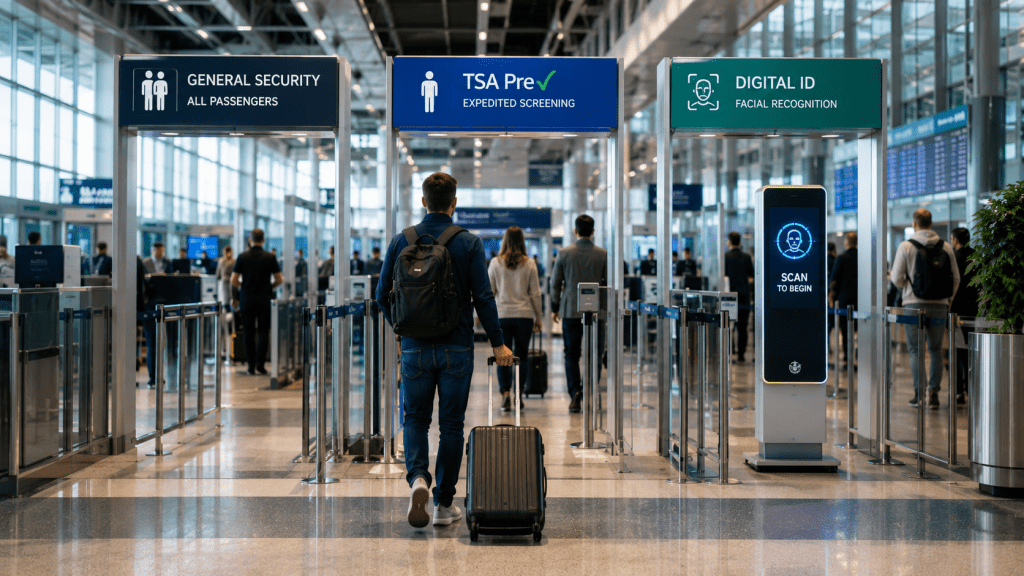
    Instead of replacing TSA screening, it verifies your identity using facial recognition or fingerprints before you reach the TSA officer.

    Then you’re escorted to the front of the ID verification line.

    Today, CLEAR Plus costs about $219 per year, although many premium credit cards and airline loyalty programs include it for free or at a discount.

    I’ll admit it.

    Using CLEAR feels pretty cool.

    You walk up to the kiosk.

    It recognizes your face.

    For a second, you feel like you’ve stepped into the future.

    A couple of years ago, though, I noticed something frustrating.

    I was getting randomly asked to show my driver’s license so often that it defeated much of the convenience.

    Fortunately, that seems to have improved significantly.

    When CLEAR Makes Sense

    CLEAR can absolutely save time at airports like:

    • Atlanta (ATL)
    • Denver (DEN)
    • Las Vegas (LAS)
    • Seattle (SEA)

    Especially during heavy business travel hours.

    The problem is this:

    TSA PreCheck has become so efficient that many mornings, the PreCheck line moves almost as fast as CLEAR.

    Because of that, CLEAR feels less like a necessity and more like a premium convenience.

    If your credit card pays for it?

    Absolutely use it.

    If you’re paying the full annual fee yourself?

    I’d think twice.


    Tommy’s Take: CLEAR is nice to have. TSA PreCheck is the one I’d actually pay for.


    Digital ID: The New Kid on the Block

    The newest option is airline Digital ID.

    Delta, United, and several other airlines now allow eligible travelers to verify their identity using facial recognition instead of showing a driver’s license.

    Here’s the best part:

    It’s free.

    You’ll typically need:

    • TSA PreCheck
    • A valid U.S. passport
    • An eligible airline account
    • To opt in before your trip

    Once you’re enrolled, participating airports can recognize you automatically as you move through security.

    The biggest advantage today?

    Not many people know about it.

    Because adoption is still relatively low, these dedicated lanes often move surprisingly quickly.

    Will that always be true?

    Probably not.

    As more travelers discover Digital ID, those lines will likely become busier.

    But today, it’s one of the better-kept secrets in airport security.


    Which One Should You Choose?

    You fly once or twice a year

    ✅ Get TSA PreCheck.

    That’s all you need.


    You fly every month

    Get:

    • TSA PreCheck
    • Digital ID (it’s free)
    • CLEAR if your credit card includes it

    That combination gives you the most flexibility.


    You’re deciding between TSA PreCheck and CLEAR

    Choose TSA PreCheck.

    Every single time.


    Price Comparison

    ProgramApproximate CostMy Recommendation
    TSA PreCheck~$80 for 5 years⭐⭐⭐⭐⭐ Must Have
    CLEAR Plus~$219 per year⭐⭐⭐ Nice if Included
    Airline Digital IDFree⭐⭐⭐⭐ Absolutely Sign Up

    Final Thoughts

    Airport security has changed dramatically over the last few years.

    Programs that once felt exclusive have become common, while newer technologies like Digital ID are quietly making the airport experience even easier.

    My advice is simple.

    Start with TSA PreCheck.

    If your credit card gives you CLEAR, enjoy it.

    And absolutely enroll in your airline’s Digital ID program. It costs nothing and could save you time on your next trip.

    One last piece of advice.

    No matter what security program you’re using, none of them can fix showing up late to the airport.

    Give yourself plenty of time, relax, and start your trip the right way.

    Travel smart,
    Tommy Pags