Tag: passenger experience

  • American Airlines Is Bringing Seatback Screens Back. Good. They Never Should Have Left.

    American Airlines Is Bringing Seatback Screens Back. Good. They Never Should Have Left.

    American Airlines Is Bringing Seatback Screens Back. Good. They Never Should Have Left.

    American Airlines just announced that seatback entertainment screens are coming back to its narrowbody fleet.

    My first reaction?

    Good.

    My second reaction?

    Why did they take them out in the first place?

    American is reversing a strategy that dates back to 2017, when the airline decided its new Boeing 737 MAX aircraft would not have seatback entertainment screens. At the time, American’s argument was that more than 90% of its passengers already brought a phone, tablet or laptop onboard, so it made more sense to invest in streaming entertainment and connectivity than screens built into the seats.

    On a PowerPoint presentation in a conference room somewhere, I can see how that probably made perfect sense.

    In the real world?

    I think it completely misunderstood the customer.

    Just Because I Have a Screen Doesn’t Mean I Want to Use It

    I travel with an iPhone and an iPad on virtually every flight I take.

    And ironically, I am probably not American’s best argument for bringing the screens back because I usually watch something on my iPad anyway.

    But that’s my choice.

    There is a big difference between saying, “Most passengers carry a device,” and saying, “Most passengers would prefer to use that device instead of a seatback entertainment system.”

    Those are two entirely different things.

    Your phone might be charging. You might want to text someone using the Wi-Fi. You might want to check your email while watching a movie. You might have a child with you who doesn’t have a device. Maybe you didn’t download anything before the flight. Maybe your battery is dying.

    Or maybe you simply don’t want to hold your phone or balance an iPad somewhere for three hours.

    Having a phone in your pocket doesn’t make the screen in front of you unnecessary.

    Sometimes Companies Stop Watching Their Customers

    I’ve worked in enough companies, departments and leadership teams over the years to see the human side of how decisions like this happen.

    Consumers normally see the finished decision.

    They don’t see the meetings.

    They don’t see the personalities.

    They don’t see the person who walks into a room convinced that he or she has the answer, or the people around the table who might disagree but eventually stop arguing.

    Good leadership, in my experience, isn’t simply walking into the room with the best idea.

    It’s bringing together people with different experiences, listening to them, challenging assumptions and then making the best decision possible for the customer and the business.

    Sometimes companies do that extraordinarily well.

    Sometimes somebody falls in love with an idea.

    And once that happens, an organization can spend years defending something customers never really wanted.

    I can’t tell you exactly what happened inside American Airlines in 2017, and I’m certainly not suggesting one person made this decision alone.

    But from the outside, this has always looked like one of those decisions where the spreadsheet won over the customer.

    Here’s the Research I Would Have Done

    This part isn’t complicated.

    Get on an airplane.

    Sit in economy.

    Look around.

    I do it every week.

    When I’m on an aircraft equipped with seatback entertainment, plenty of those screens are being used. My completely unscientific observation from flying is that on many flights it looks like more than half the cabin has something playing.

    Movies.

    TV shows.

    The moving map.

    Kids programming.

    Sometimes people aren’t even actively watching. The map is simply running while they’re doing something else.

    That’s customer behavior happening right in front of you.

    And here’s the important part: those passengers often have phones sitting next to them too.

    The seatback screen didn’t replace their device.

    It complemented it.

    That distinction seems obvious today, but apparently it wasn’t obvious enough in 2017.

    American Is Now Making a Very Big U-Turn

    This isn’t American putting screens on a handful of new airplanes.

    The airline says it plans to install seatback entertainment at every seat across its narrowbody fleet, including both new aircraft and retrofitted planes. New aircraft deliveries with screens are expected to begin in 2028, with the broader rollout continuing into the early part of the next decade.

    And these aren’t going to be the clunky airline screens many of us remember from years ago.

    American says the new system will include:

    • 4K displays
    • Bluetooth connectivity for wireless headphones
    • USB-C fast charging
    • Personalized entertainment
    • Enhanced flight maps
    • Movies, television, music and games
    • Integration alongside American’s upcoming Starlink Wi-Fi

    American is also increasing premium seating on its narrowbody fleet from roughly 25% of seats today to about 40% in the coming years.

    So clearly this is part of something bigger.

    American is trying to make its domestic product feel more premium and compete more directly with Delta and United.

    That makes sense.

    This Reminds Me of the CarPlay Debate

    There’s a similar corporate mindset happening in the automotive industry.

    Some automakers have moved away from Apple CarPlay and Android Auto in favor of their own integrated systems.

    Again, maybe there is a terrific business case for doing that.

    But there’s a simple customer question that has to come first:

    What does the customer actually want?

    People already live inside the ecosystems on their phones.

    They have their apps.

    Their music.

    Their messages.

    Their navigation preferences.

    Their contacts.

    Their podcasts.

    When someone buys a $50,000 vehicle, telling them they can’t use the interface they already prefer because the manufacturer has decided something else is better can feel incredibly tone deaf.

    The airline screen decision strikes me the same way.

    Technology should give customers more choices, not take choices away from them.

    Want to watch your iPad?

    Great.

    Want to stream American’s entertainment to your phone?

    Great.

    Want to put your phone down, connect your AirPods to the screen in front of you and watch a movie?

    You should be able to do that too.

    But There’s Still Something More Important Than the Screen

    I give American credit for reversing course.

    Companies don’t always do that.

    Sometimes the hardest words for a large organization to say are essentially, “We got this one wrong.”

    And American is putting real money behind the reversal.

    But if I’m American Airlines and I’m making a list of what passengers really want from me, a beautiful 4K entertainment system isn’t at the top.

    Get me where I’m going.

    Get me there safely.

    Get me there reasonably close to the time you told me I would arrive.

    Handle disruptions well when something goes wrong.

    Treat customers like human beings when their travel plans fall apart.

    Then we can talk about the television.

    The entertainment system absolutely affects the experience, particularly when American wants to position itself as a premium full-service airline.

    But reliability is still the product.

    Everything else is an amenity.

    My Take

    I think American made the wrong call in 2017.

    Not because phones and tablets weren’t becoming more important. American was absolutely right about that.

    The mistake was assuming one technology had to replace the other.

    Nearly a decade later, American seems to have reached the same conclusion.

    Your phone isn’t replacing the airplane screen.

    Your airplane screen isn’t replacing your phone.

    They can coexist.

    And sometimes the best market research isn’t another survey, consulting report or executive presentation.

    Sometimes you just need to sit in 28C, look around the cabin and watch what your customers are actually doing.

    American finally appears to have looked around.

    Better late than never.

    Travel Smart,

    Tommy Pags
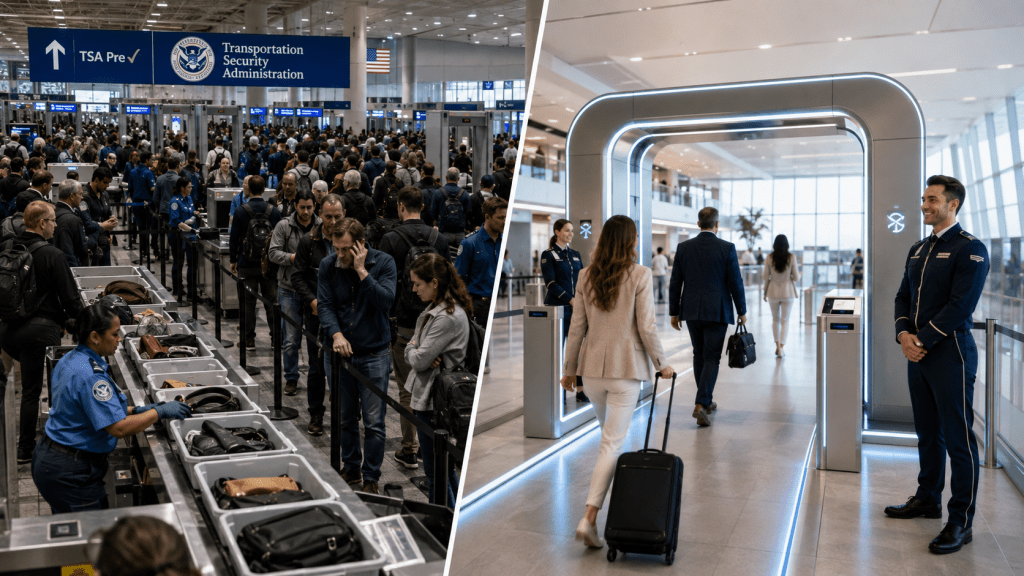
  • Three Airports Are Replacing TSA Screeners. I Hope Every Airport Is Next.

    Three Airports Are Replacing TSA Screeners. I Hope Every Airport Is Next.

    Three Airports Are Replacing TSA Screeners. I Hope Every Airport Is Next.

    Private security will still operate under federal standards, but it could bring something airport screening desperately needs: accountability.

    Three major airports are preparing to replace federally employed TSA screeners with private security contractors, and I think it is a fantastic idea.

    Tampa International Airport, Charleston International Airport, and Des Moines International Airport are set to become the first participants in a new program called TSA Gold+. Current projections call for the transition to begin at Des Moines in January 2027, Charleston in February 2027, and Tampa in May 2027.

    Before anyone pictures airports abandoning security regulations or returning to the inconsistent system that existed before September 11, that is not what is happening.

    TSA will continue setting the security standards. It will oversee the contractors, conduct inspections, perform covert testing, and retain federal security directors at participating airports. The private screeners must meet the same federal training and certification requirements as TSA officers. What changes is who employs the screeners, who manages the checkpoint, and, under the expanded Gold+ program, who can purchase and deploy some of the technology.

    In other words, this is not an elimination of federal oversight.

    It is an attempt to combine federal security standards with private-sector accountability.

    And I hope it works.

    Government Agencies Do Not Operate Like Businesses

    This is not intended as a personal attack against TSA officers. Most TSA employees are ordinary people trying to perform a difficult, repetitive, and frequently thankless job.

    The problem is the system surrounding them.

    A government agency does not operate under the same incentives as a private business. If a TSA checkpoint develops two-hour lines, passengers miss flights, families become frustrated, and the entire terminal backs up, TSA does not lose the airport’s business the following morning.

    There is no competing federal screening agency waiting to take its place.

    The airport cannot simply fire TSA and select a better provider. Travelers cannot choose a different checkpoint operator. The agency continues operating and continues receiving government funding.

    A private contractor works under a very different reality.

    Its contract can include measurable requirements for staffing, wait times, training, threat detection, customer satisfaction, and checkpoint throughput. Its performance can be reviewed. Its contract can be penalized, rebid, or ultimately given to another company.

    That does not guarantee perfection, but it creates accountability.

    TSA’s existing Screening Partnership Program already requires private screeners to provide security equal to or greater than the level provided by federal screeners. TSA has also established performance standards covering hiring, training, and the ability to detect threat objects during testing.

    The difference is simple: one organization is permanently assigned to the airport, while the other must continue earning the right to operate there.

    Security Must Be About More Than Looking Secure

    The most important argument for private airport security is not shorter lines.

    It is safety.

    TSA has experienced some deeply troubling results during undercover security tests.

    In 2015, officials briefed on a Department of Homeland Security Inspector General investigation said TSA screeners failed 67 of 70 undercover tests. Investigators were reportedly able to move simulated weapons and explosives through checkpoints in 95 percent of the attempts.

    Another round of covert testing in 2017 again found serious vulnerabilities. The official results were classified, but reporting at the time indicated that screeners or screening procedures failed more than half the tests, with one source describing an estimated 80 percent failure rate as being “in the ballpark.”

    Those tests are not current performance measurements, and TSA has made changes since they were conducted. But they demonstrate an important point: simply making screeners federal employees does not automatically make a checkpoint secure.

    The Department of Homeland Security Inspector General identified problems involving personnel, equipment, and procedures. A later Government Accountability Office review found that TSA improved its covert-testing program, but had not fully established an effective process for resolving vulnerabilities discovered during those tests. As of September 2018, nine vulnerabilities identified since 2015 had not been formally resolved.

    That is where private-sector accountability could matter.

    If a contractor repeatedly misses weapons, fails inspections, understaffs checkpoints, or ignores corrective actions, there should be contractual consequences. Security failures should threaten the company’s ability to keep the business.

    Private screening will never eliminate human error. No serious person should promise that it will. But a system in which performance directly affects whether a company retains its contract creates a much stronger incentive to identify weaknesses and correct them quickly.

    Innovation Should Include the Entire Experience

    Airport security innovation is usually discussed in terms of equipment.

    New scanners. Better identification technology. Automated screening lanes. Artificial intelligence. Touchless identity verification.

    Those developments matter, but technology is only part of the checkpoint.

    Real innovation should also examine how passengers enter the line, how bins are distributed, how bags are returned, how families are assisted, how staffing changes during peak periods, how travelers receive instructions, and how quickly lanes can be opened when passenger volume suddenly increases.

    A private operator has a reason to study every step.

    Under TSA Gold+, participating contractors may be able to fund and deploy technology on a commercial schedule instead of waiting through the full federal procurement and appropriations process. Tampa International Airport says that could allow technology to arrive faster while improving throughput, security, and customer experience.

    Tampa also reported that its passenger satisfaction score for TSA screening fell to its lowest level during the most recent government shutdown, ranking 45th among 56 participating airports in the Airports Council International customer survey.

    That matters.

    Travelers are not cargo being processed through a warehouse. Security must be thorough, but it can also be organized, professional, understandable, and respectful.

    A safe checkpoint does not have to be a miserable checkpoint.

    Private Screening Is Not Entirely New

    TSA Gold+ may sound like a radical experiment, but private screening under federal oversight has existed for more than two decades.

    Approximately 20 airports already use private screening contractors through TSA’s Screening Partnership Program. Participating airports include San Francisco International Airport, Kansas City International Airport, Atlantic City International Airport, and Orlando Sanford International Airport.

    San Francisco is particularly significant because it demonstrates that private screening is not limited to tiny regional airports.

    SFO is a major international airport and one of the busiest airports in the country. Its private contractor operates the checkpoints while TSA retains federal authority and oversight. Aviation security experts have pointed to San Francisco as evidence that the model can work at scale.

    The model has another advantage: stability during government shutdowns.

    Federal TSA officers are classified as essential employees and must continue working during shutdowns, even when their paychecks are temporarily stopped. As shutdowns continue, absenteeism can rise and checkpoints can become understaffed.

    Private screening contractors are generally paid through previously funded federal contracts, allowing their operations and payroll to continue. San Francisco officials have said that arrangement helped the airport maintain screening operations during previous shutdowns.

    Airport security should not depend on whether politicians in Washington can pass a budget.

    Private Does Not Automatically Mean Better

    There is an important warning that cannot be ignored.

    A private company can also perform poorly. A contractor could cut staffing, reduce training, chase profits, or attempt to meet the minimum standard at the lowest possible cost.

    The Government Accountability Office has previously found that comparisons between private and federal screeners contained enough methodological limitations that broad conclusions about which group performed better could not reliably be made.

    That means privatization alone is not the solution.

    The solution is privatization combined with strong federal standards, independent testing, transparent performance measurements, meaningful contract requirements, and the willingness to replace companies that fail.

    TSA should remain the regulator.

    It should establish the security requirements, conduct inspections, perform covert tests, certify workers, investigate failures, and enforce national standards.

    But it does not necessarily need to employ every person operating every checkpoint.

    The government can set the rules without running the entire operation.

    I Hope More Airports Follow

    I would be happy to see every airport in the country seriously consider moving to private security screening under TSA oversight.

    Not because private companies are automatically perfect. They are not.

    Not because every TSA officer is doing a poor job. That is clearly not true.

    I support it because the current system separates performance from consequences.

    A better model would make security companies compete on safety, efficiency, technology, staffing, and the passenger experience. It would allow airports to demand improvement. It would give operators a reason to innovate. Most importantly, it would create a mechanism for replacing an organization that consistently fails to perform.

    Airport security is too important to become a permanent government routine where long lines, outdated systems, inconsistent instructions, and security failures are accepted as unavoidable.

    Tampa, Charleston, and Des Moines are about to test another way.

    I hope they succeed.

    And I hope every other airport is watching.

    Travel smart,
    Tommy Pags