
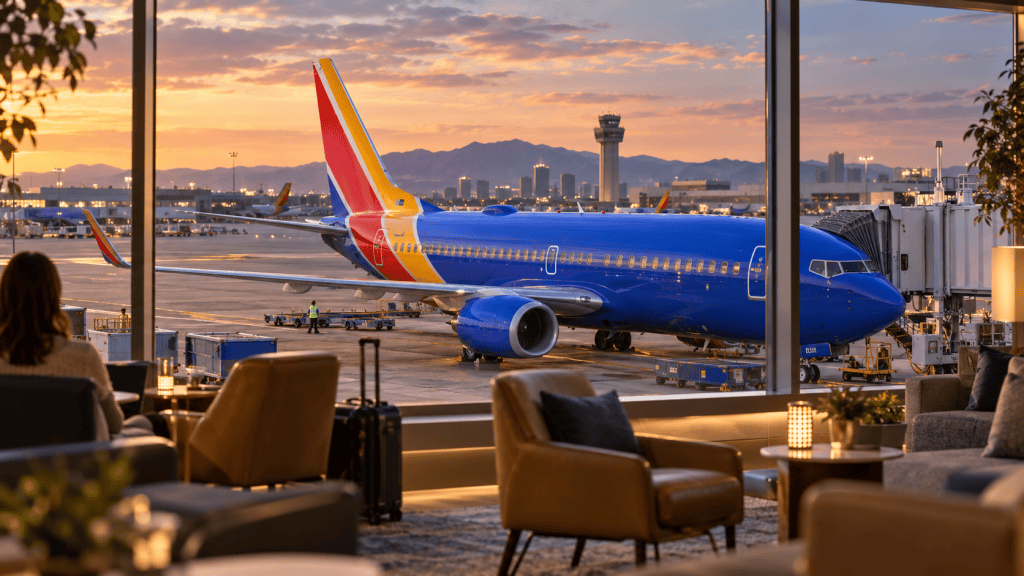
Is Southwest Trying to Become a Premium Airline? The Transformation Is Getting Hard to Ignore
For most of my traveling life, Southwest Airlines has existed in its own little corner of the airline world.
It wasn’t really trying to be Delta.
It wasn’t really trying to be United.
And it definitely wasn’t trying to impress you with a fancy airport lounge, assigned seat, or some elaborate premium cabin.
Southwest was Southwest.
Two bags flew free. You checked in 24 hours before departure and hoped for a decent boarding position. There were no assigned seats. There was no first class. There were no airport lounges.
And if you understood the system, there was something refreshingly simple about it.
Well, that Southwest is changing. Fast.
And after the airline’s latest announcement, I think we need to start asking a different question:
Is Southwest trying to become a premium airline?
I don’t think we’re quite there yet.
But Southwest is absolutely trying to become an airline that premium travelers take seriously.
And that’s a much bigger change than simply assigning seats.
First, Southwest Got Rid of Open Seating
This was probably the first change that made longtime Southwest flyers realize something major was happening.
In July 2024, Southwest announced that it would abandon the open-seating system it had used for more than 50 years.
Assigned seating officially began on January 27, 2026.
Instead of boarding the airplane and choosing whichever seat is available, Southwest now operates much more like its competitors.
Passengers can choose among Standard, Preferred, and Extra Legroom seats depending on the fare they purchase, their Rapid Rewards status, or their Southwest credit card benefits.
Extra Legroom seats offer up to five additional inches of pitch on some aircraft, and Southwest has positioned those seats as its more premium onboard experience.
No, this isn’t Delta First Class or United Polaris.
There isn’t even a separate premium cabin.
But Southwest suddenly has something it never really had before:
A meaningful way to sell a better seat to a customer willing to spend more money.
That’s important.
Then Came the Bags
This might have been an even bigger change.
For years, “Bags Fly Free” wasn’t simply a Southwest perk.
It was part of the airline’s identity.
In fact, here’s what makes this part of the story fascinating.
At Southwest’s September 2024 Investor Day, the airline said its own research showed that two free checked bags were so important to customers that eliminating the benefit could actually hurt demand more than the bag fees would generate in revenue.
In other words:
Bags Fly Free was staying.
Less than six months later, Southwest announced it was ending two free checked bags for most passengers.
Beginning May 28, 2025, most travelers started paying to check bags unless they qualified through their fare, elite status, or a Southwest Rapid Rewards credit card.
And as of September 2026, most mainland travelers purchasing Basic, Choice, or Choice Preferred fares pay $45 for the first checked bag and $55 for the second.
That’s a pretty dramatic change for an airline that spent decades marketing itself as the airline that didn’t nickel-and-dime you.
Southwest Started Flying Red-Eyes
Here’s another change that doesn’t get as much attention.
Southwest historically wasn’t really a 24-hour airline.
That started changing in February 2025 when Southwest launched its first scheduled overnight red-eye flights.
That might sound like a small scheduling change, but operationally it matters.
Red-eyes allow Southwest to use its airplanes more efficiently, connect more markets, and behave more like a traditional network carrier.
An airplane sitting on the ground overnight isn’t making any money.
An airplane flying passengers across the country overnight is.
That’s Airline Economics 101.
Southwest Started Looking Beyond Its Own Network
This is another major departure from the Southwest many of us grew up with.
Southwest traditionally operated as a very self-contained airline.
You flew Southwest.
Then you got off the Southwest airplane.
That was pretty much it.
Now Southwest is developing partnerships with international airlines that can connect its domestic network with destinations around the world.
It started with Icelandair.
Today, Southwest’s partner lineup has expanded dramatically and includes airlines such as ANA, EVA Air, Singapore Airlines, Turkish Airlines, TAP Air Portugal, Condor, China Airlines, Philippine Airlines, Air Premia, LOT Polish Airlines, and Icelandair.
Suddenly, Southwest isn’t thinking only about getting someone from Baltimore to Orlando.
It is participating in a much larger global travel ecosystem.
That starts sounding a lot more like a network airline.
Then Came Free Wi-Fi
In October 2025, Southwest began offering free inflight Wi-Fi to Rapid Rewards members through a partnership with T-Mobile.
And importantly, you don’t have to be a T-Mobile customer.
You simply need a Rapid Rewards account.
For someone like me who spends a lot of time on airplanes and often works while traveling, Wi-Fi isn’t really a luxury anymore.
It’s part of the product.
Delta understood that.
Other airlines are moving in that direction.
Southwest clearly understands it too.
Southwest Is Selling Vacations Now, Too
In August 2025, Southwest launched Getaways by Southwest, its own vacation-packaging business.
Customers can package airfare with hotels, rental cars, and other travel components directly through Southwest.
Again, this isn’t necessarily something that makes an airline “premium.”
But it shows something bigger happening.
Southwest wants a larger piece of the travel relationship.
It doesn’t just want your airline ticket.
It wants your loyalty.
It wants your credit card spending.
It wants your vacation booking.
And now it wants to be part of your airport experience before you ever get on the airplane.
Which brings us to the announcement that really caught my attention.
Southwest Is Getting Airport Lounges
Yes.
Southwest Airlines lounges.
Beginning in late 2027, Southwest plans to open its first airport lounges in partnership with Chase.
The first four are planned for Austin, Baltimore, Honolulu, and Nashville.
And Southwest says at least seven additional lounges are planned over the following years.
The lounges are expected to offer many of the things we’ve come to expect from premium airport lounges, including comfortable spaces, food and beverages, places to work, charging, and locally inspired design.
Southwest is also planning a new premium Rapid Rewards credit card from Chase in 2027 that will include access to the lounge network.
That is a very different Southwest Airlines.
Is Southwest Really Becoming a Premium Carrier?
This is where I think we need to be careful.
Southwest isn’t suddenly Delta or United.
There still isn’t a traditional first-class cabin.
There isn’t a lie-flat business-class seat.
There isn’t a huge international long-haul network operated by Southwest aircraft.
The airline still flies an all-Boeing 737 fleet, and even its premium seating today is essentially a better economy seat with additional legroom.
So calling Southwest a premium airline today is probably going too far.
But saying Southwest wants premium customers?
I think that’s undeniable.
Assigned seats.
Extra-legroom seating.
Premium fare bundles.
Red-eye flights.
International airline partnerships.
Free Wi-Fi.
Vacation packages.
A more sophisticated loyalty and credit-card strategy.
And now airport lounges.
Those things aren’t happening accidentally.
Southwest is moving directly toward the customers that Delta, United, and American have spent years fighting over.
And This Is Where It Gets Interesting for Me
When I think about the major U.S. carriers from my own perspective as a frequent traveler, I tend to put Delta and United in their own battle at the top.
They each do certain things better than the other.
American, for me, has always felt like a pretty distant third.
That’s my personal travel perspective, not some scientific airline ranking.
And Southwest?
I’ve never really included Southwest in that conversation.
Not because Southwest isn’t a huge airline.
It is.
But its product was fundamentally different.
If I wanted lounges, premium seating, a more traditional frequent-flyer experience, and the kind of network that works for someone who travels frequently, Southwest wasn’t really the airline I was comparing with Delta or United.
That is starting to change.
I’m Watching Southwest Differently Now
I’ve mentioned before that while I’m certainly not ready to say I’m “done” with Delta, United has been getting more and more of my attention.
I like a lot of what United is doing.
Their network works well for me.
Their premium product is compelling.
Their lounges and airport experience are improving.
And they seem very focused on competing for frequent travelers.
But now I’m looking at Southwest and thinking:
Maybe I need to give these guys another look too.
Especially as the next pieces of this transformation arrive.
If Southwest eventually adds a true first-class product, continues expanding international partnerships, builds a legitimate lounge network, and improves the onboard experience while maintaining some of that Southwest personality people genuinely like, they could become a very interesting competitor.
And Reuters recently reported that Southwest CEO Bob Jordan has even suggested longer-haul international flying and true first-class seating could eventually be possibilities.
Now that would really change the conversation.
But Southwest Has to Be Careful
There is one danger in all of this.
Southwest became successful because it wasn’t Delta, United, or American.
People understood the deal.
The product was simple.
The airline had personality.
Two bags flew free.
There weren’t 15 different ways to pay extra for something.
As Southwest becomes more like everybody else, it has to make sure it doesn’t simply become everybody else.
Because if Southwest charges bag fees, charges for better seats, sells premium credit cards, assigns seats, and starts building lounges, travelers are eventually going to compare Southwest directly with Delta and United.
And that means the product has to hold up.
That’s the tradeoff.
Southwest can absolutely move upstream and attract more premium travelers.
But once you enter that arena, customers start expecting a premium experience.
My Two Cents
I think this might be one of the most interesting airline transformations happening in the United States right now.
Southwest isn’t just tweaking a few policies.
It is systematically changing almost every element that once made Southwest different from the legacy airlines.
Some longtime Southwest customers probably aren’t going to like that.
I understand why.
If you loved Southwest because of open seating and two free checked bags, you’re watching the airline eliminate some of the exact reasons you chose it.
But from the perspective of someone who flies frequently and values the entire travel experience, I’m intrigued.
Give me a good assigned seat.
Give me reliable Wi-Fi.
Give me extra legroom.
Give me a lounge where I can work before the flight.
Give me meaningful loyalty benefits.
Give me useful partnerships when I travel internationally.
And suddenly I’m paying attention.
I’m not ready to put Southwest alongside Delta and United yet.
But for the first time in a long time, I think Southwest actually wants to get into that conversation.
And by 2027, we may be looking at a very different airline than the Southwest we all thought we knew.
Travel smart,
Tommy Pags
 Pags on the Go