Tag: TSA

  • Frequent Flyers vs. Vacation Travelers: Why Airports Sometimes Feel Like Two Different Worlds

    Frequent Flyers vs. Vacation Travelers: Why Airports Sometimes Feel Like Two Different Worlds

    Frequent Flyers vs. Vacation Travelers: Why Airports Sometimes Feel Like Two Different Worlds

    If you’ve ever gotten “the look” at the airport, don’t take it personally.

    You know the one.

    You’re standing at the front of the TSA line when you suddenly realize your laptop is buried underneath three sweatshirts, your water bottle is still full, your boarding pass disappeared somewhere between the parking garage and security, and now an entire line of people is standing behind you.

    Meanwhile, somewhere back there is a frequent flyer quietly thinking…

    “Please… not today.”

    Here’s the thing.

    They’re probably not mad at you.

    They’re just trying to get home.

    There Are Really Two Different Airports

    One of the funny things about flying is that everyone is using the same airport, but they’re having completely different experiences.

    For the occasional traveler, flying is an event.

    It’s vacation.
    It’s Disney.
    It’s visiting Grandma.
    It’s the cruise you’ve been counting down to for six months.

    Everything is exciting. You have time to browse the gift shops, admire the giant art installations, grab a cinnamon roll, and look out the windows at the airplanes.

    There’s nothing wrong with that.

    In fact, I hope you enjoy every minute of it.

    Frequent flyers, however, live in an entirely different world.

    We’re usually flying for work.

    We’ve already spent several days away from home, slept in hotels, attended meetings, rented cars, and eaten one too many airport meals. By the time we’re heading home, there’s only one thing on our minds:

    Get. Me. Home.

    Airports Become Muscle Memory

    When you fly every week, airports stop feeling like airports.

    They become routines.

    You already know which security checkpoint moves faster.

    You know which escalator to take.

    You know which restroom is usually empty.

    You know which coffee line isn’t worth waiting in.

    You know exactly when boarding starts, when overhead bins fill up, and where to stand without blocking everyone else.

    You’re not trying to rush because you’re impatient.

    You’re moving on autopilot.

    Think about walking through your own grocery store.

    You don’t stop to admire the cereal aisle every week.

    You already know exactly where everything is.

    Airports become that familiar.

    The Biggest Slowdown Isn’t Walking

    It’s uncertainty.

    Confusion creates delays.

    Someone isn’t sure whether liquids stay in the bag.

    Someone forgot they have a full bottle of water.

    Someone reaches the X-ray belt and suddenly starts reorganizing their entire suitcase.

    Someone waits until they’re standing in the aircraft doorway before deciding which overhead bin to use.

    None of those things are a big deal individually.

    But multiply them by hundreds of travelers every day, and suddenly flights board slower, security lines back up, and connections become tighter for everyone.

    The Plane Door Is Not the Best Time to Make Decisions

    Every frequent flyer has experienced this moment.

    The boarding line moves smoothly.

    Everything is perfect.

    Then someone steps onto the aircraft…

    …and stops.

    They look left.

    They look right.

    They examine every overhead bin.

    They take off a backpack.

    Then put it back on.

    Then take it off again.

    Meanwhile, forty people behind them have come to a complete stop.

    We’ve all laughed about it because we’ve all seen it.

    Again, nobody is angry because someone is new.

    It’s simply that everyone behind them has been standing in line for fifteen minutes and now the entire airplane has paused while decisions are being made.

    A Little Preparation Goes a Long Way

    If you don’t travel often, don’t worry.

    Nobody expects you to know every airport procedure.

    But there are a few things that make life easier for everyone:

    • Have your ID and boarding pass ready before you reach the TSA officer.
    • Empty your pockets before you get to the scanner.
    • Know whether your airport requires laptops or liquids to come out.
    • Finish your water before security.
    • Once you reach your airplane row, put your bag away and move into your seat so the next person can keep moving.

    These aren’t unwritten rules designed by impatient business travelers.

    They’re simply habits that keep thousands of people moving efficiently.

    Frequent Flyers Can Do Better Too

    Let’s be fair.

    Frequent flyers aren’t always innocent.

    Sometimes we forget that not everyone flies fifty times a year.

    Sometimes we’re impatient.

    Sometimes we sigh a little louder than necessary.

    Sometimes we forget that our routine is someone else’s once-a-year adventure.

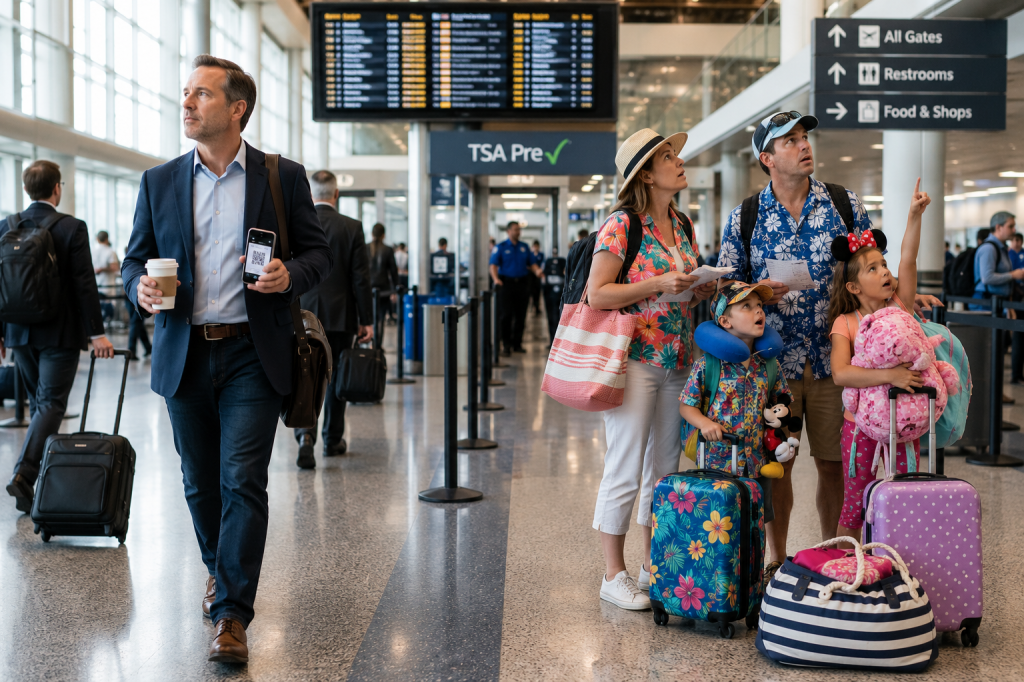
    That family taking pictures at the gate?

    Those kids seeing airplanes up close for the first time?

    That retired couple heading to Hawaii?

    Good for them.

    I genuinely hope they have an incredible trip.

    A little patience works both ways.

    The Bottom Line

    If a frequent flyer seems frustrated, chances are it isn’t about you personally.

    They’re probably thinking about getting home after another week on the road.

    They’re thinking about dinner with their family.

    Their kids’ baseball game.

    Sleeping in their own bed.

    Likewise, if you’re an occasional traveler, remember that the people moving quickly around you probably aren’t trying to be rude.

    They’re simply operating in a world they’ve learned through hundreds of flights.

    We’re all trying to reach the same destination.

    Some of us are just taking our fiftieth flight this year, while others are taking our first.

    A little awareness, a little patience, and maybe a little humor make the airport a better place for everyone.

    After all, whether you’re headed to an important business meeting or the vacation of a lifetime, we’re all hoping for exactly the same thing:

    An on-time departure, an empty middle seat, and a baggage carousel that actually delivers our suitcase first.


    Travel smart,

    Tommy Pags
  • TSA PreCheck vs. CLEAR vs. Digital ID: Which One Is Actually Worth Your Money?

    TSA PreCheck vs. CLEAR vs. Digital ID: Which One Is Actually Worth Your Money?

    TSA PreCheck vs. CLEAR vs. Digital ID: Which One Is Actually Worth Your Money?

    If you spend any amount of time in airports, you’ve probably noticed something.

    There are really two types of travelers.

    One group practically lives in airports. They’re business travelers, road warriors, airline elites, and the people who know exactly which Starbucks has the shortest line in Terminal B.

    The other group flies once or twice a year. Maybe it’s a family vacation, a cruise, or a trip to visit Grandma.

    Those are two very different travelers, but today’s airport security programs have something to offer both.

    The question is simple:

    Which ones are actually worth paying for?

    After years of flying almost every week, here’s my take on TSA PreCheck, CLEAR, and the newer Digital ID programs.


    TSA PreCheck: Still the Best Value

    If I could only recommend one program, it would be TSA PreCheck.

    Every time.

    For about $80 for five years, you’re paying roughly $16 a year to make one of the worst parts of flying dramatically easier.

    With TSA PreCheck you’ll usually:

    • Keep your shoes on
    • Leave your laptop in your bag
    • Leave liquids packed away
    • Move through a much faster security line

    Could you occasionally arrive at an airport where the regular security line is moving just as fast?

    Of course.

    It happens.

    But during the busiest travel periods, especially early morning departures and evening rushes, that’s rarely the case.

    Even if you only fly once or twice a year, I still think it’s worth it.

    When you break the cost down, you’re spending less than one airport sandwich each year to remove a huge amount of travel stress.

    That’s an easy decision.


    Tommy’s Take: If you’re only going to buy one airport security program, buy TSA PreCheck.


    CLEAR: Convenient, But Harder to Justify

    CLEAR works differently.

    Instead of replacing TSA screening, it verifies your identity using facial recognition or fingerprints before you reach the TSA officer.

    Then you’re escorted to the front of the ID verification line.

    Today, CLEAR Plus costs about $219 per year, although many premium credit cards and airline loyalty programs include it for free or at a discount.

    I’ll admit it.

    Using CLEAR feels pretty cool.

    You walk up to the kiosk.

    It recognizes your face.

    For a second, you feel like you’ve stepped into the future.

    A couple of years ago, though, I noticed something frustrating.

    I was getting randomly asked to show my driver’s license so often that it defeated much of the convenience.

    Fortunately, that seems to have improved significantly.

    When CLEAR Makes Sense

    CLEAR can absolutely save time at airports like:

    • Atlanta (ATL)
    • Denver (DEN)
    • Las Vegas (LAS)
    • Seattle (SEA)

    Especially during heavy business travel hours.

    The problem is this:

    TSA PreCheck has become so efficient that many mornings, the PreCheck line moves almost as fast as CLEAR.

    Because of that, CLEAR feels less like a necessity and more like a premium convenience.

    If your credit card pays for it?

    Absolutely use it.

    If you’re paying the full annual fee yourself?

    I’d think twice.


    Tommy’s Take: CLEAR is nice to have. TSA PreCheck is the one I’d actually pay for.


    Digital ID: The New Kid on the Block

    The newest option is airline Digital ID.

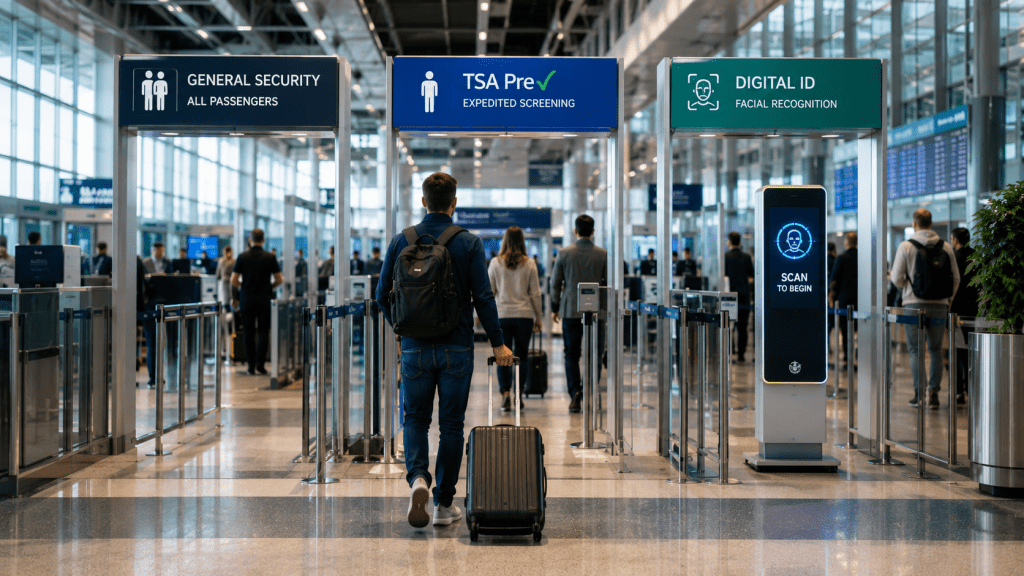
    Delta, United, and several other airlines now allow eligible travelers to verify their identity using facial recognition instead of showing a driver’s license.

    Here’s the best part:

    It’s free.

    You’ll typically need:

    • TSA PreCheck
    • A valid U.S. passport
    • An eligible airline account
    • To opt in before your trip

    Once you’re enrolled, participating airports can recognize you automatically as you move through security.

    The biggest advantage today?

    Not many people know about it.

    Because adoption is still relatively low, these dedicated lanes often move surprisingly quickly.

    Will that always be true?

    Probably not.

    As more travelers discover Digital ID, those lines will likely become busier.

    But today, it’s one of the better-kept secrets in airport security.


    Which One Should You Choose?

    You fly once or twice a year

    ✅ Get TSA PreCheck.

    That’s all you need.


    You fly every month

    Get:

    • TSA PreCheck
    • Digital ID (it’s free)
    • CLEAR if your credit card includes it

    That combination gives you the most flexibility.


    You’re deciding between TSA PreCheck and CLEAR

    Choose TSA PreCheck.

    Every single time.


    Price Comparison

    ProgramApproximate CostMy Recommendation
    TSA PreCheck~$80 for 5 years⭐⭐⭐⭐⭐ Must Have
    CLEAR Plus~$219 per year⭐⭐⭐ Nice if Included
    Airline Digital IDFree⭐⭐⭐⭐ Absolutely Sign Up

    Final Thoughts

    Airport security has changed dramatically over the last few years.

    Programs that once felt exclusive have become common, while newer technologies like Digital ID are quietly making the airport experience even easier.

    My advice is simple.

    Start with TSA PreCheck.

    If your credit card gives you CLEAR, enjoy it.

    And absolutely enroll in your airline’s Digital ID program. It costs nothing and could save you time on your next trip.

    One last piece of advice.

    No matter what security program you’re using, none of them can fix showing up late to the airport.

    Give yourself plenty of time, relax, and start your trip the right way.

    Travel smart,
    Tommy Pags

  • TSA Is Finally Cracking Down on Oversized Carry-Ons. Good.

    TSA Is Finally Cracking Down on Oversized Carry-Ons. Good.

    TSA Is Finally Cracking Down on Oversized Carry-Ons. Good.

    If you’ve flown recently, you’ve probably seen it.

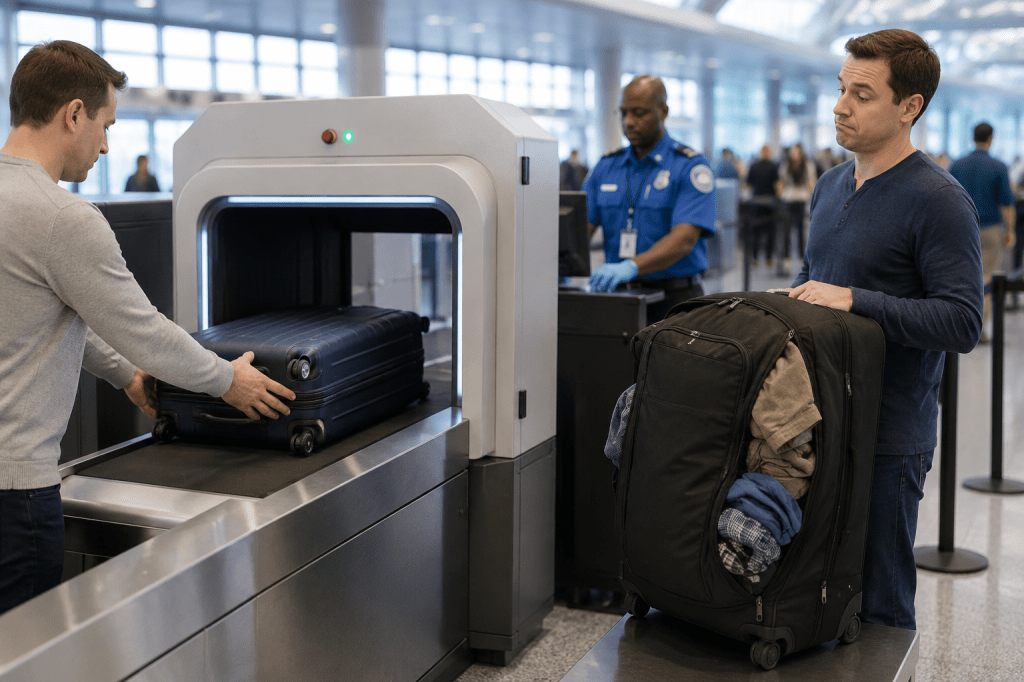
    Someone shows up at the TSA checkpoint with a carry-on that’s bulging at the seams, barely zips shut, and somehow is expected to fit through security, into the overhead bin, and not delay everyone else.

    That may be coming to an end.

    The TSA is rolling out advanced 3D CT scanners at airports across the country. Besides providing much better security screening, these machines have a smaller opening than many of the older X-ray scanners. If your carry-on won’t physically fit through the scanner, you may be sent back to the airline counter to check it before you can continue through security. In many cases, that means leaving the security line, checking the bag, and starting the process all over again. (New Jersey 101.5)

    The Rules Aren’t New

    This is an important distinction.

    The TSA isn’t changing carry-on size limits.

    The airlines already have those rules. For most major U.S. carriers, the standard maximum carry-on size is 22 x 14 x 9 inches, although every airline publishes its own baggage policy. (Yahoo Travel)

    What’s changing is enforcement.

    For years, many travelers pushed the limits. Overstuffed bags, oversized rollers, duffel bags that somehow became twice their normal size. Sometimes they made it through security only to be gate checked later. Sometimes they somehow squeezed into an overhead bin after holding up the boarding process.

    The new scanners don’t care how persuasive you are.

    If the bag doesn’t fit, it doesn’t fit.

    This Is One TSA Change I Completely Support

    I know this probably won’t be a popular opinion with everyone, but I’m all for it.

    If you’ve followed Pags on the Go, you know I’m constantly looking for ways to make air travel smoother.

    The biggest slowdowns at an airport usually happen when something falls outside the normal process.

    That could be:

    • An oversized carry-on
    • A bag stuffed beyond its intended size
    • Someone trying to bring unusual items through security
    • Travelers who aren’t prepared when they reach the checkpoint
    • People reorganizing their luggage in the middle of the line

    Every exception creates friction.

    One person takes an extra minute, then the next person waits, then the next, and before long the entire checkpoint slows to a crawl.

    Multiply that by hundreds of travelers every day, and the delays become significant.

    Frequent Travelers Already Understand This

    There are different types of travelers.

    Some people fly once or twice a year for vacation.

    Others live in airports.

    Business travelers and frequent flyers aren’t trying to rush because they’re impatient. They’re trying to eliminate unnecessary delays.

    That’s why they enroll in TSA PreCheck, CLEAR, or Digital ID.

    That’s why they board efficiently.

    That’s why they pack consistently.

    And that’s why they appreciate anything that keeps the line moving.

    When everyone follows the same process, the entire airport works better.

    Better Technology, Better Security

    The new CT scanners aren’t just about baggage size.

    They produce a three-dimensional image of your carry-on that allows TSA officers to rotate, zoom, and inspect its contents far more effectively than older X-ray systems. At many checkpoints, they also allow travelers to leave laptops and other electronics inside their bags, reducing the amount of unpacking at security. More than 250 U.S. airport checkpoints have already received these scanners, with additional installations planned. (New Jersey 101.5)

    So while stricter carry-on enforcement is getting the headlines, the real story is that airport security is becoming both smarter and, in many cases, faster.

    My Advice

    Before your next trip:

    • Measure your carry-on instead of guessing.
    • Don’t overstuff expandable luggage.
    • Check your airline’s published carry-on dimensions before you leave home.
    • If your bag is questionable, check it before getting in the TSA line.

    A few extra minutes at home can save you from being sent back to the ticket counter after you’ve already waited in security.

    For once, I think this is a change that benefits everyone.

    Less arguing.

    Less congestion.

    Fewer oversized bags competing for overhead space.

    And hopefully, a faster trip through the airport.

    That’s something I can get behind.

    Travel smart,
    Tommy Pags