Tag: United Airlines

  • No Ticket? No Problem: TSA Is Bringing Back the Airport Gate Goodbye

    No Ticket? No Problem: TSA Is Bringing Back the Airport Gate Goodbye

    No Ticket? No Problem: TSA Is Bringing Back the Airport Gate Goodbye

    For nearly 25 years, one of the most human parts of air travel has been missing.

    You drive someone to the airport. You unload the bags. Maybe you get a quick hug at the curb. And depending on the airport, if you sit there for more than about 14 seconds, you start wondering whether airport police are going to make you circle the terminal again.

    Then your traveler walks through the doors.

    That’s it.

    You don’t sit with them before their flight. You don’t grab lunch together. You don’t walk them to the gate. You don’t watch their airplane pull away. And when someone you love comes home, you usually wait around baggage claim instead of being the first familiar face they see when they step off the jet bridge.

    For most of us, that has simply become part of flying.

    But TSA is beginning to change that.

    A new program called Gateside by TSA PreCheck is allowing eligible people who are not flying to pass through airport security and enter the secure side of participating airports.

    And I absolutely love this idea.

    What Is Gateside by TSA PreCheck?

    Gateside by TSA PreCheck allows eligible trusted travelers who do not have an airline ticket to apply for access beyond the security checkpoint at participating airports.

    In other words, you may be able to go through TSA without actually having a flight.

    Think about what that means.

    You could walk a family member to the gate.

    You could meet someone the moment they arrive.

    You could visit a friend who has a long layover.

    You could accompany someone who is nervous about traveling and stay with them until it is time to board.

    Or you could simply enjoy some of the restaurants, shops and other amenities located inside the secure portion of an airport.

    TSA launched the program in September 2026 at 13 airports, with the potential for additional airports to be added as the program develops.

    The initial airports include:

    Mesa Gateway Airport in Arizona

    John Glenn Columbus International Airport

    Dallas Fort Worth International Airport

    Detroit Metropolitan Wayne County Airport

    Wichita Dwight D. Eisenhower National Airport

    Indianapolis International Airport

    Harry Reid International Airport in Las Vegas

    Los Angeles International Airport

    Bill and Hillary Clinton National Airport in Little Rock

    Will Rogers International Airport in Oklahoma City

    Eppley Airfield in Omaha

    San Diego International Airport

    Salt Lake City International Airport

    You Still Have to Go Through Security

    This does not mean TSA is simply opening the doors and allowing anyone into the terminal.

    Gateside is built around the trusted traveler system.

    Participants need qualifying TSA PreCheck benefits and a Known Traveler Number or another eligible trusted traveler credential. You apply before your visit, receive approval, bring proper identification to the airport and go through TSA screening.

    Airport security rules still apply.

    TSA can also limit the number of Gateside visitors based on security conditions and airport capacity.

    So no, this is not a return to the completely open airport terminals of decades ago.

    It is something smarter.

    It combines modern airport security with the ability to bring back something air travel lost a long time ago.

    This Gives TSA PreCheck an Entirely New Kind of Value

    I already think TSA PreCheck is one of the better investments a frequent traveler can make.

    But Gateside changes the value of PreCheck in an interesting way.

    Until now, TSA PreCheck was something you used when you were traveling.

    Now it could have value when somebody else is traveling.

    Maybe you only fly a couple of times a year and have wondered whether TSA PreCheck is worth paying for.

    Now imagine your son or daughter is taking their first trip alone.

    Maybe your parents are flying somewhere and you want to help them navigate the airport.

    Maybe your spouse is leaving on a long trip.

    Maybe your best friend has a four-hour connection through your local airport.

    Or maybe a family member you haven’t seen in a year is finally coming home.

    Suddenly, your trusted traveler membership can be useful even when you are not getting on an airplane.

    That is a completely different benefit.

    And I think it is a very smart one.

    Airports Can Become Places Again

    Something changed about airports after September 11, 2001, and understandably so.

    Security had to change.

    Before 9/11, family and friends could generally accompany travelers to their gates. After the attacks, the security checkpoint became a dividing line between passengers and everyone else.

    That change served an important purpose.

    But we also lost something.

    Airports used to be part of the experience.

    People dressed differently when they traveled. Flying felt like an occasion.

    Families went to the airport together.

    Kids stood at huge terminal windows watching airplanes taxi.

    People said goodbye at the gate.

    Someone returning home might step off an airplane and see an entire family waiting for them.

    Today, air travel often feels much more transactional.

    Get dropped off.

    Check your bag.

    Clear security.

    Find the gate.

    Board the plane.

    Repeat.

    Gateside brings a little humanity back into that process.

    Imagine the Arrivals

    This may be the part of the program that I like the most.

    Imagine a servicemember coming home and walking off the jet bridge to see family waiting at the gate.

    Imagine your grandson flying in to visit and seeing Grandpa standing there when he arrives.

    Imagine somebody coming home after being away for six months and seeing a ridiculous homemade welcome sign waiting for them.

    Those moments used to be part of flying.

    Now, at least at participating airports, they can be again.

    And I think that matters.

    There is something completely different about walking off an airplane and immediately seeing the person you came home to see.

    Not 20 minutes later at baggage claim.

    Not after navigating escalators, trams and crowds.

    Right there.

    At the gate.

    It Could Make Travel Easier for Nervous Travelers

    There is another side to Gateside that deserves attention.

    Not everyone loves flying.

    Some people are anxious travelers.

    Some people are flying for the first time.

    Some people have no problem with the airplane itself but find large airports confusing or intimidating.

    Until now, unless there was a qualifying circumstance that allowed an airline to issue an escort pass, friends and family usually had to say goodbye before security.

    Gateside creates another possibility.

    A trusted family member or friend may be able to go through security with you, help you find your gate, grab something to eat, sit with you and stay until boarding begins.

    It does not replace airline assistance programs or accessibility services for travelers who need them.

    It simply gives people another option.

    Sometimes having someone you know sitting beside you is the best travel assistance there is.

    And Don’t Overlook the Restaurants

    Frequent travelers know something that people who rarely fly may not realize.

    Airport food has gotten a lot better.

    Sure, there are still plenty of overpriced grab-and-go sandwiches that can make you reconsider every decision that brought you to that moment.

    But many airports now have great local restaurants, breweries, chef-driven concepts, shopping, lounges, art installations and other experiences beyond security.

    Gateside suddenly gives some non-travelers access to that world.

    Have a friend with a three-hour layover?

    You might be able to meet them for dinner.

    Want to take your grandchild to watch airplanes and grab lunch?

    Potentially.

    Want to spend another hour with someone before a long trip rather than dropping them at the curb?

    Now there may be another option.

    The airport does not have to be somewhere you only go because you are flying.

    It can become a place again.

    Philadelphia Travelers Already Have Something Similar

    There is an important distinction for travelers in the Philadelphia area.

    Philadelphia International Airport is not currently one of the airports participating in Gateside by TSA PreCheck.

    However, PHL already operates its own program called Wingmate Pass.

    Wingmate allows approved non-ticketed visitors to enter the secure side of Philadelphia International Airport to accompany someone to a gate, greet a domestic arrival or enjoy airport restaurants, shopping and other amenities.

    Unlike Gateside, Wingmate does not require TSA PreCheck membership.

    Programs like Wingmate are important because they show that airports have already been experimenting with bringing non-ticketed visitors back into secure terminals.

    What makes Gateside especially interesting is that TSA itself is now building a broader program around its trusted traveler system.

    That could make this concept much easier to expand.

    I Think the Golden Age of Air Travel May Be Coming Back

    I keep saying something that might sound a little crazy.

    I think we may be seeing the beginning of a new golden age of air travel.

    No, I don’t think everyone is going to start wearing suits and dresses to fly again.

    And based on what I see in airports every week, I think pajamas are probably here to stay.

    But I do think the travel industry is beginning to think differently about the customer experience.

    For years, so much of flying has been focused on efficiency.

    Move people through security faster.

    Board the airplane faster.

    Turn the aircraft faster.

    Move passengers from Point A to Point B.

    Those things matter.

    But somewhere along the way, the experience itself became secondary.

    Now we are starting to see technology and new programs being used to make travel enjoyable again.

    United Airlines, for example, is currently testing a program at Newark Liberty International Airport where eligible passengers can order food, drinks and certain travel essentials through the United app and have those items waiting for them at the gate.

    United has said Houston is also expected to receive the program later in 2026.

    Think about how useful that could be during a tight connection.

    Instead of getting off one airplane, sprinting through Newark, standing in a restaurant line and then running to your next gate, your food could already be there waiting for you.

    That may sound like a small change.

    It isn’t.

    Small improvements like that can completely change how stressful a travel day feels.

    I’ll be talking more about that program in another Pags on the Go article.

    Maybe the Airport Can Be Fun Again

    I don’t expect us to recreate air travel from the 1960s.

    And frankly, we probably shouldn’t.

    The so-called golden age of aviation gets romanticized. Flying was much more expensive relative to household income, far fewer people could afford it and there were plenty of things about the experience that were not nearly as glamorous as the old photographs make them look.

    But there was something about travel that I think we lost.

    It felt special.

    Going to the airport meant something.

    Leaving meant something.

    Coming home meant something.

    Maybe the next golden age of air travel does not need to look like the old one.

    Maybe we create a new version.

    One that keeps modern aviation security but uses trusted traveler programs intelligently.

    One where technology removes some of the frustrating parts of travel instead of creating new ones.

    One where airports become places worth spending time again.

    One where families can walk together to the gate.

    One where a nervous traveler does not necessarily have to say goodbye before security.

    One where a child can stand at the terminal window with Grandpa and watch airplanes taxi.

    And one where somebody can step off a plane after a long journey and see the person they love standing there holding a sign.

    That may seem like a small thing.

    I don’t think it is.

    Travel has always been about more than moving people from Point A to Point B.

    It is about leaving.

    It is about arriving.

    It is about who you are going to see.

    And sometimes, it is about who is standing there when you get there.

    Gateside by TSA PreCheck brings a little piece of that back.

    I hope it comes to a lot more airports.

    Travel smart,
    Tommy Pags

  • Basic Economy Just Got Even Worse for Frequent Flyers: Here’s Why I’m Avoiding It

    Basic Economy Just Got Even Worse for Frequent Flyers: Here’s Why I’m Avoiding It

    Basic Economy Just Got Even Worse for Frequent Flyers: Here’s Why I’m Avoiding It


    Basic Economy Isn’t the Bargain It Used to Be

    There was a time when booking Basic Economy came with a few compromises. You might lose seat selection or board a little later, but if you were a loyal customer with airline status, you still earned something for your loyalty.

    Those days are over.

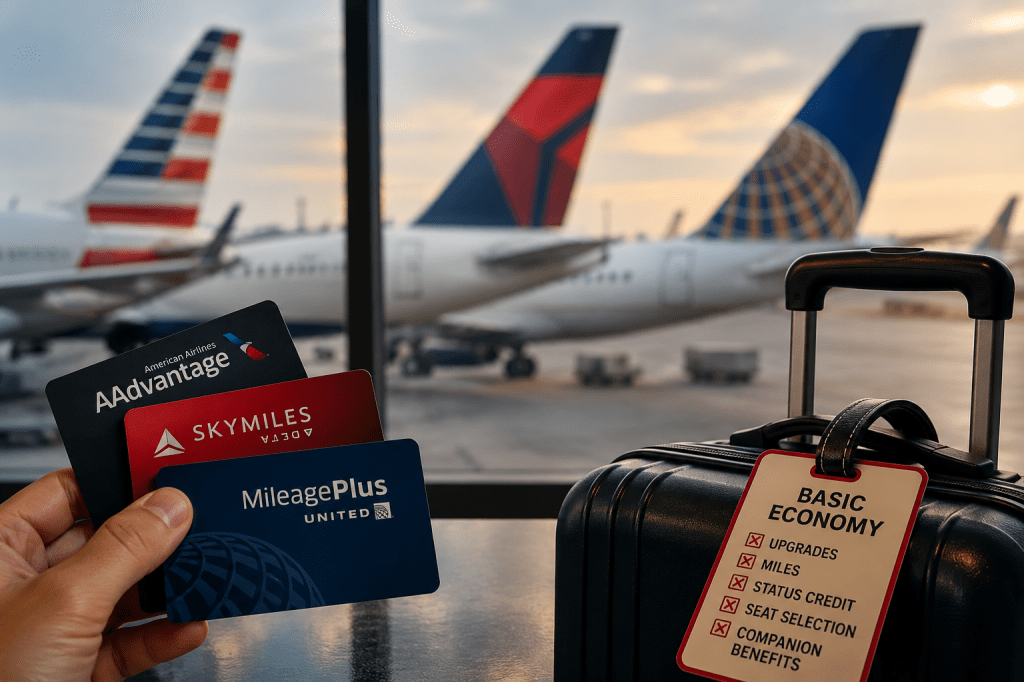
    American Airlines, Delta Air Lines, and United Airlines have all made it clear: if you buy Basic Economy, don’t expect your elite status to help you much anymore.

    For travelers chasing status, this isn’t just another policy change. It completely changes the value equation.


    The New Reality

    The biggest change is simple.

    If you’re flying Basic Economy:

    • No redeemable miles on many qualifying fares.
    • No progress toward elite status.
    • No complimentary upgrades.
    • Reduced or eliminated elite benefits.
    • In many cases, fewer opportunities to use the perks you’ve spent years earning.

    American officially eliminated mileage earning on Basic Economy tickets in late 2025. Delta and United have continued moving in the same direction, making their lowest fares little more than transportation from Point A to Point B.

    The message from the airlines couldn’t be clearer:

    Want loyalty benefits? Buy a more expensive ticket.


    This Hits Frequent Travelers the Hardest

    As someone who flies almost every week, this caught my attention.

    For years I was a Delta loyalist. If you’ve been following Pags on the Go, you already know my relationship with Delta has become… complicated.

    Lately I’ve seen Delta pricing become dramatically more expensive than United and American on many of my regular routes. Sometimes we’re talking hundreds of dollars more for essentially the same trip.

    Now they’re asking frequent travelers to pay even more just to preserve the benefits we’ve already worked hard to earn.

    That doesn’t sit particularly well with me.


    Loyalty Programs Are Becoming Revenue Programs

    This is the part that I think many travelers are missing.

    Airline loyalty programs used to reward how often you flew.

    Today they reward how much money you spend.

    That’s a huge philosophical shift.

    The airlines have figured out something simple:

    Business travelers, corporate travelers, and premium leisure travelers are willing to pay more.

    Instead of rewarding frequency, they’re rewarding revenue.

    From a business standpoint, I understand it.

    From a customer standpoint, it certainly feels different than it did even five years ago.


    Should You Ever Book Basic Economy?

    For many travelers, the answer is actually…

    Yes.

    If you fly once or twice a year…

    If you don’t care about airline status…

    If you’re simply looking for the cheapest possible fare…

    Basic Economy may still make perfect sense.

    But if you’re chasing elite status, trying to earn upgrades, or hoping to keep your Gold, Platinum, Executive Platinum, Premier, Medallion, or similar level…

    Basic Economy has become a trap.

    The savings on the ticket can easily cost you far more in lost benefits later.


    My Rule of Thumb

    Here’s how I look at it.

    If Main Cabin is only $30 to $75 more than Basic Economy, I almost always choose Main Cabin.

    Why?

    Because I want:

    • Seat selection.
    • Flexibility if plans change.
    • Miles earned.
    • Credit toward future status.
    • Better upgrade opportunities.
    • The ability to actually use the loyalty program I’m investing in.

    Those benefits usually outweigh the small upfront savings.


    One More Thing to Watch

    One detail that deserves attention is codeshare flights.

    If you’re booking through one airline but flying on another, Basic Economy restrictions don’t always match what you expect. The operating airline’s rules often determine which benefits you actually receive.

    Before clicking “Purchase,” take a minute to verify exactly what you’re buying.

    That five-minute check could save you a lot of frustration at the airport.


    Final Thoughts

    I’ve said it before on this site, and I think it applies here too:

    Airline loyalty is becoming a two-way negotiation.

    The airlines expect us to stay loyal.

    But they also have to earn ours.

    When ticket prices climb, benefits shrink, and elite status becomes harder to maintain, travelers should feel comfortable shopping around. Blind loyalty doesn’t make much sense anymore.

    Book the airline that gives you the best overall value, not just the one with the logo you’ve been flying for years.

    That’s exactly what I’ve started doing.

    Travel smart,
    Tommy Pags
  • TSA PreCheck vs. CLEAR vs. Digital ID: Which One Is Actually Worth Your Money?

    TSA PreCheck vs. CLEAR vs. Digital ID: Which One Is Actually Worth Your Money?

    TSA PreCheck vs. CLEAR vs. Digital ID: Which One Is Actually Worth Your Money?

    If you spend any amount of time in airports, you’ve probably noticed something.

    There are really two types of travelers.

    One group practically lives in airports. They’re business travelers, road warriors, airline elites, and the people who know exactly which Starbucks has the shortest line in Terminal B.

    The other group flies once or twice a year. Maybe it’s a family vacation, a cruise, or a trip to visit Grandma.

    Those are two very different travelers, but today’s airport security programs have something to offer both.

    The question is simple:

    Which ones are actually worth paying for?

    After years of flying almost every week, here’s my take on TSA PreCheck, CLEAR, and the newer Digital ID programs.


    TSA PreCheck: Still the Best Value

    If I could only recommend one program, it would be TSA PreCheck.

    Every time.

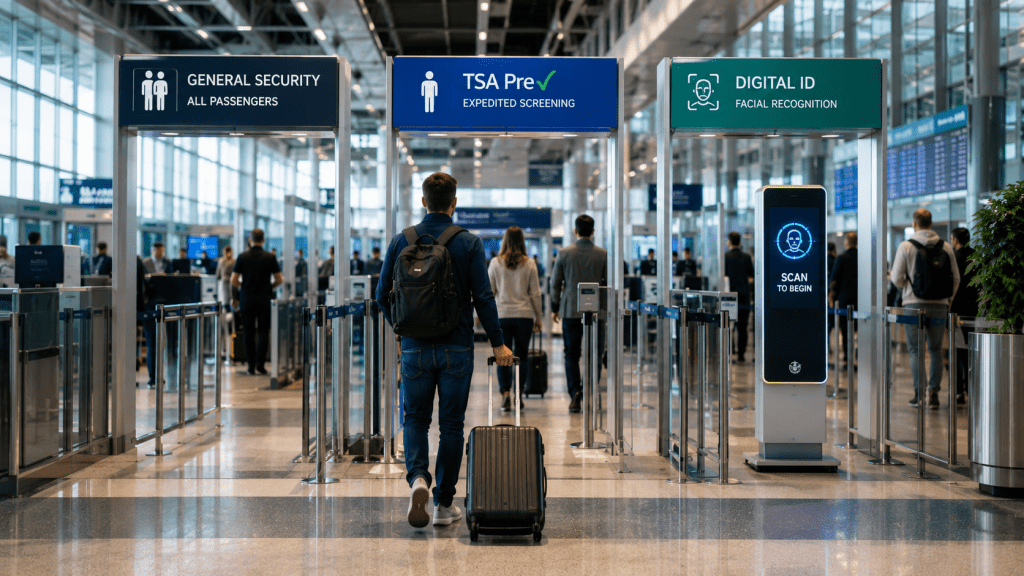
    For about $80 for five years, you’re paying roughly $16 a year to make one of the worst parts of flying dramatically easier.

    With TSA PreCheck you’ll usually:

    • Keep your shoes on
    • Leave your laptop in your bag
    • Leave liquids packed away
    • Move through a much faster security line

    Could you occasionally arrive at an airport where the regular security line is moving just as fast?

    Of course.

    It happens.

    But during the busiest travel periods, especially early morning departures and evening rushes, that’s rarely the case.

    Even if you only fly once or twice a year, I still think it’s worth it.

    When you break the cost down, you’re spending less than one airport sandwich each year to remove a huge amount of travel stress.

    That’s an easy decision.


    Tommy’s Take: If you’re only going to buy one airport security program, buy TSA PreCheck.


    CLEAR: Convenient, But Harder to Justify

    CLEAR works differently.

    Instead of replacing TSA screening, it verifies your identity using facial recognition or fingerprints before you reach the TSA officer.

    Then you’re escorted to the front of the ID verification line.

    Today, CLEAR Plus costs about $219 per year, although many premium credit cards and airline loyalty programs include it for free or at a discount.

    I’ll admit it.

    Using CLEAR feels pretty cool.

    You walk up to the kiosk.

    It recognizes your face.

    For a second, you feel like you’ve stepped into the future.

    A couple of years ago, though, I noticed something frustrating.

    I was getting randomly asked to show my driver’s license so often that it defeated much of the convenience.

    Fortunately, that seems to have improved significantly.

    When CLEAR Makes Sense

    CLEAR can absolutely save time at airports like:

    • Atlanta (ATL)
    • Denver (DEN)
    • Las Vegas (LAS)
    • Seattle (SEA)

    Especially during heavy business travel hours.

    The problem is this:

    TSA PreCheck has become so efficient that many mornings, the PreCheck line moves almost as fast as CLEAR.

    Because of that, CLEAR feels less like a necessity and more like a premium convenience.

    If your credit card pays for it?

    Absolutely use it.

    If you’re paying the full annual fee yourself?

    I’d think twice.


    Tommy’s Take: CLEAR is nice to have. TSA PreCheck is the one I’d actually pay for.


    Digital ID: The New Kid on the Block

    The newest option is airline Digital ID.

    Delta, United, and several other airlines now allow eligible travelers to verify their identity using facial recognition instead of showing a driver’s license.

    Here’s the best part:

    It’s free.

    You’ll typically need:

    • TSA PreCheck
    • A valid U.S. passport
    • An eligible airline account
    • To opt in before your trip

    Once you’re enrolled, participating airports can recognize you automatically as you move through security.

    The biggest advantage today?

    Not many people know about it.

    Because adoption is still relatively low, these dedicated lanes often move surprisingly quickly.

    Will that always be true?

    Probably not.

    As more travelers discover Digital ID, those lines will likely become busier.

    But today, it’s one of the better-kept secrets in airport security.


    Which One Should You Choose?

    You fly once or twice a year

    ✅ Get TSA PreCheck.

    That’s all you need.


    You fly every month

    Get:

    • TSA PreCheck
    • Digital ID (it’s free)
    • CLEAR if your credit card includes it

    That combination gives you the most flexibility.


    You’re deciding between TSA PreCheck and CLEAR

    Choose TSA PreCheck.

    Every single time.


    Price Comparison

    ProgramApproximate CostMy Recommendation
    TSA PreCheck~$80 for 5 years⭐⭐⭐⭐⭐ Must Have
    CLEAR Plus~$219 per year⭐⭐⭐ Nice if Included
    Airline Digital IDFree⭐⭐⭐⭐ Absolutely Sign Up

    Final Thoughts

    Airport security has changed dramatically over the last few years.

    Programs that once felt exclusive have become common, while newer technologies like Digital ID are quietly making the airport experience even easier.

    My advice is simple.

    Start with TSA PreCheck.

    If your credit card gives you CLEAR, enjoy it.

    And absolutely enroll in your airline’s Digital ID program. It costs nothing and could save you time on your next trip.

    One last piece of advice.

    No matter what security program you’re using, none of them can fix showing up late to the airport.

    Give yourself plenty of time, relax, and start your trip the right way.

    Travel smart,
    Tommy Pags