
Tag: Frequent Travelers

  • The Most Important Part of a Business Hotel Might Be Helping You Stop Working

    The Most Important Part of a Business Hotel Might Be Helping You Stop Working

    The Most Important Part of a Business Hotel Might Be Helping You Stop Working

    I spend a lot of time traveling for work, and there’s one thing people sometimes forget about business travel.

    Just because I’m traveling for work doesn’t mean I want to work 24 hours a day.

    Hyatt recently commissioned a survey of 2,000 U.S. business travelers, and one number immediately caught my attention.

    Ninety percent said their hotel room was the only place they truly felt “off the clock” during a business trip.

    I completely understand that.

    Because after spending the day working with customers, attending meetings, standing at a trade show, traveling between appointments or dealing with airports, there comes a point where you need the day to end.

    And sometimes the only place where that actually happens is when the hotel room door closes behind you.

    A Business Hotel Has to Do Two Things

    Here’s the challenge.

    I still need to work in my hotel room.

    There are emails that need responses. There may be reports to finish, presentations to adjust or preparation for the next morning.

    Hyatt’s research found that nearly three-quarters of the business travelers surveyed typically do some work in their hotel rooms after the normal workday.

    Again, I get it.

    That’s why I want a legitimate desk or work area.

    I want a comfortable chair.

    I want enough outlets.

    I want strong Wi-Fi.

    And please, hotel designers, put outlets somewhere that makes sense.

    But once I’m finished, I want that room to transition from office back to hotel room.

    That’s the part I think some hotels miss.

    I Don’t Want to Sleep in My Office

    There’s a difference between having a good workspace in a hotel room and having a room that feels like somebody shoved a bed into an office.

    A business hotel needs to let me work efficiently so I can finish what I need to do and then put the laptop away.

    After that, I want to relax.

    Watch television.

    Order something to eat.

    Call home.

    Take a shower.

    Maybe scroll through my phone for longer than I should.

    And sleep.

    That’s normal.

    Business travel already blurs the line between work and personal time. A good hotel shouldn’t blur it even more.

    The Little Things Become Big Things

    The Hyatt survey found business travelers placed a premium on things such as comfortable beds, reliable Wi-Fi, food availability, breakfast and early check-in.

    None of those things sound revolutionary.

    That’s exactly the point.

    When you travel regularly, consistency beats gimmicks.

    I’d rather have great Wi-Fi than an app-controlled curtain.

    I’d rather have a comfortable mattress than mood lighting with six different settings.

    I’d rather have easily accessible outlets than a decorative telephone I’ll never touch.

    And when I’ve been traveling all day, having food available without needing another Uber can feel like a luxury.

    The best business hotels understand that.

    Give Me a Good Desk

    I do think the desk deserves more attention.

    Hotels increasingly design rooms around leisure travelers, and some properties have reduced the traditional work area to a tiny table or shelf.

    That doesn’t always work for business travelers.

    Sometimes I actually need to spread out.

    Laptop.

    Phone.

    Chargers.

    Notebook.

    Maybe paperwork.

    Possibly an iPad.

    I don’t need a corporate cubicle in my room, but I need enough functional space to work comfortably for an hour or two.

    The faster I can finish my work, the faster I can stop working.

    That’s the real benefit.

    Then Let Me Shut the World Off

    Nearly half of the travelers in Hyatt’s study said they would rather spend their downtime relaxing alone in the room than attend an optional networking event.

    That doesn’t surprise me either.

    There’s only so much talking a person can do.

    Business trips can involve spending almost every waking minute around people.

    Customers.

    Coworkers.

    Convention attendees.

    Restaurant servers.

    Uber drivers.

    Airport crowds.

    People sitting next to you on airplanes.

    Sometimes the best amenity a hotel can give you is simply a quiet room and a closed door.

    What I Look For

    The longer I travel, the more I appreciate hotels that get the basics right.

    For business travel, my ideal room isn’t necessarily luxurious.

    It’s functional.

    I want:

    • A comfortable bed
    • A real work surface
    • A comfortable desk chair
    • Fast, reliable Wi-Fi
    • Accessible outlets
    • Good lighting
    • A strong shower
    • Effective blackout shades
    • A room that stays quiet
    • Good climate control
    • Food available reasonably late
    • A television that actually works easily

    None of that belongs in a hotel commercial.

    All of it matters when you’re actually staying there.

    Loyalty Matters Too

    Another interesting result from Hyatt’s study was that 80% of respondents said hotel loyalty programs influence where they stay for business.

    That makes sense.

    If work requires you to spend nights away from home, earning points, elite status and benefits toward future travel at least gives you something back.

    But loyalty only goes so far.

    I won’t keep staying somewhere uncomfortable simply because there’s a logo on the building.

    The hotel still has to do its job.

    My Take

    A business hotel doesn’t have to entertain me every minute.

    It has to make my trip easier.

    Give me somewhere I can work when I need to work.

    Give me what I need to get that work done efficiently.

    Then give me a comfortable place where work can stop.

    Because business travelers aren’t traveling machines.

    We’re still people.

    And at some point during every business trip, the laptop needs to close.

    Travel smart,
    Tommy Pags.
  • Google’s AI Can Book Your Hotel. But I Think Travelers Should Fight AI With AI.

    Google’s AI Can Book Your Hotel. But I Think Travelers Should Fight AI With AI.

    Google’s AI Can Book Your Hotel. But I Think Travelers Should Fight AI With AI.

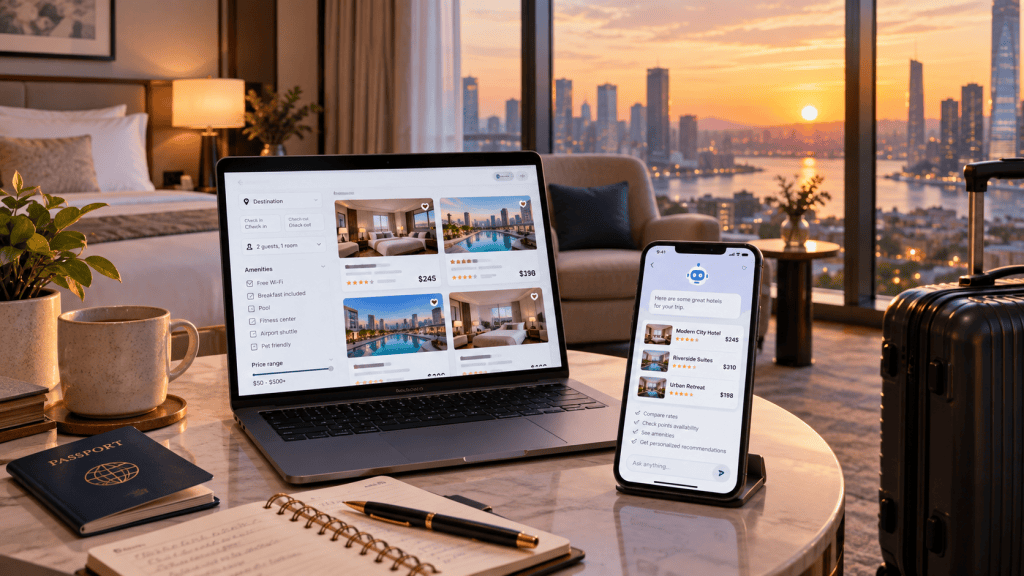
    Artificial intelligence has already worked its way into almost every part of travel planning. Now it is moving one step closer to actually making the reservation for you.

    Google announced on August 27 that its AI Mode in Search is adding new travel capabilities, including the ability to compare hotel options, see some hotel prices in points, and complete hotel bookings with participating partners.

    That is a pretty significant change.

    But the part that interests me most isn’t simply that AI can book my hotel.

    I want to use AI to figure out whether the hotel AI wants me to book is actually the best hotel for me.

    Welcome to AI versus AI.

    Booking a Hotel Is About More Than the Lowest Rate

    If all I cared about was finding the cheapest room, hotel shopping would be pretty easy.

    That’s rarely how I travel.

    If you’re part of a hotel loyalty program, carry travel credit cards, have elite status or travel frequently for work, the room rate is only one piece of the equation.

    A hotel that costs $20 more per night may actually be the cheaper choice when you factor in:

    • Complimentary breakfast
    • Parking costs
    • Resort or destination fees
    • Lounge access
    • Possible room upgrades
    • Early check-in
    • Late checkout
    • Hotel points earned
    • Promotional bonus points
    • Credit card statement credits
    • Cancellation flexibility
    • Free Wi-Fi
    • Transportation costs based on location

    Suddenly, that $179 hotel may be a much better deal than the one listed for $159.

    This is where I think AI becomes extremely useful for travelers.

    Let AI Do the Math

    Google’s new AI travel tools are moving in the direction of becoming something closer to a digital travel agent.

    You can tell AI Mode where you’re going, when you’re traveling and what you’re looking for. Google can then return hotel choices and, with participating partners, help complete the reservation.

    It can also show points pricing for participating hotel loyalty programs.

    That’s convenient.

    But before I hit the button, I’d take the hotels I’m considering and run my own analysis.

    For example, I might give an AI assistant something like this:

    “I’m staying in Denver for three nights. I’m comparing these three hotels. I’m a member of these loyalty programs and have this elite status. Compare the total cost of each hotel, including parking and destination fees. Factor in breakfast, lounge access, late checkout, upgrades, points earned, current promotions, cancellation rules and distance from where I need to be. Tell me which benefits are guaranteed and which are only based on availability. Then rank the hotels by total value, not just room rate.”

    Now I’m not simply asking AI to find a room.

    I’m asking it to help me make a travel decision.

    That’s much more valuable.

    The Merchant of Record Matters

    There is another detail travelers need to pay attention to.

    Google says that when hotels are booked through AI Mode, the hotel company or booking platform involved in the transaction remains the merchant of record and handles customer service.

    That’s important.

    If the reservation ultimately goes through the hotel chain, great.

    If it goes through an online travel agency, I want to know that before booking.

    Hotel loyalty programs commonly treat qualifying direct reservations differently from certain third-party bookings. Depending on the program and reservation, booking through an online travel agency can affect points, elite-night credit and elite benefits.

    So one of my questions before clicking “book” will always be:

    Who am I actually booking with?

    Convenience isn’t worth unknowingly giving up benefits.

    AI Still Needs a Human in the Loop

    I use technology constantly when I travel, but I don’t think we should confuse convenience with accuracy.

    AI can compare information incredibly quickly, but hotel policies change. Promotions expire. Elite benefits vary. Parking costs change. A lounge can close. A hotel can be undergoing renovations.

    So I would still verify the few pieces of information that could materially affect my trip.

    Especially cancellation policies.

    If AI tells me one hotel includes breakfast and another doesn’t, that’s helpful.

    Before booking five nights based on that answer, I’m checking.

    Think of AI as the person doing the research for you, not the person ultimately responsible for the decision.

    That part is still yours.

    This Could Completely Change Hotel Search

    For years the basic process has been pretty predictable.

    Search a city.

    Scroll through hotels.

    Open 15 tabs.

    Check Google reviews.

    Check the hotel website.

    Check your loyalty account.

    Check points.

    Check parking.

    Check the map.

    Forget which hotel was in which tab.

    Start over.

    AI has the potential to take a lot of that friction out of the process.

    Instead of searching for a specific hotel, we may increasingly say:

    “Find me a quiet Marriott or Hilton near the convention center with a good desk, breakfast, a gym, late checkout and parking under $30. I want to earn points and don’t want a resort fee.”

    That’s a very different way of searching.

    And probably a better one.

    My Take

    I’m not worried about AI becoming part of travel booking.

    I’m interested in what happens when travelers start using the same technology for themselves.

    If an algorithm is deciding which hotels to put in front of me, I want my own technology helping me decide whether those recommendations make sense.

    Don’t just ask AI where to stay.

    Ask it why.

    Ask it what you’re getting.

    Ask what you’re giving up.

    Ask what the real cost is after fees.

    Ask what your loyalty status is worth.

    Then make the decision yourself.

    That’s when AI stops being a gimmick and starts becoming a genuinely useful travel tool.

    Travel smart,
    Tommy Pags.