
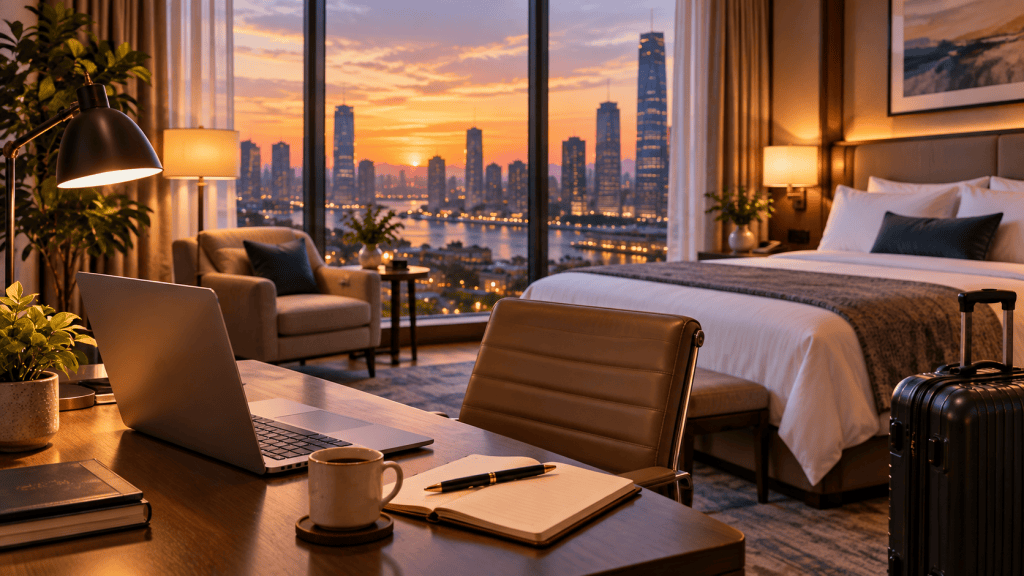
The Most Important Part of a Business Hotel Might Be Helping You Stop Working
I spend a lot of time traveling for work, and there’s one thing people sometimes forget about business travel.
Just because I’m traveling for work doesn’t mean I want to work 24 hours a day.
Hyatt recently commissioned a survey of 2,000 U.S. business travelers, and one number immediately caught my attention.
Ninety percent said their hotel room was the only place they truly felt “off the clock” during a business trip.
I completely understand that.
Because after spending the day working with customers, attending meetings, standing at a trade show, traveling between appointments or dealing with airports, there comes a point where you need the day to end.
And sometimes the only place where that actually happens is when the hotel room door closes behind you.
A Business Hotel Has to Do Two Things
Here’s the challenge.
I still need to work in my hotel room.
There are emails that need responses. There may be reports to finish, presentations to adjust or preparation for the next morning.
Hyatt’s research found that nearly three-quarters of the business travelers surveyed typically do some work in their hotel rooms after the normal workday.
Again, I get it.
That’s why I want a legitimate desk or work area.
I want a comfortable chair.
I want enough outlets.
I want strong Wi-Fi.
And please, hotel designers, put outlets somewhere that makes sense.
But once I’m finished, I want that room to transition from office back to hotel room.
That’s the part I think some hotels miss.
I Don’t Want to Sleep in My Office
There’s a difference between having a good workspace in a hotel room and having a room that feels like somebody shoved a bed into an office.
A business hotel needs to let me work efficiently so I can finish what I need to do and then put the laptop away.
After that, I want to relax.
Watch television.
Order something to eat.
Call home.
Take a shower.
Maybe scroll through my phone for longer than I should.
And sleep.
That’s normal.
Business travel already blurs the line between work and personal time. A good hotel shouldn’t blur it even more.
The Little Things Become Big Things
The Hyatt survey found business travelers placed a premium on things such as comfortable beds, reliable Wi-Fi, food availability, breakfast and early check-in.
None of those things sound revolutionary.
That’s exactly the point.
When you travel regularly, consistency beats gimmicks.
I’d rather have great Wi-Fi than an app-controlled curtain.
I’d rather have a comfortable mattress than mood lighting with six different settings.
I’d rather have easily accessible outlets than a decorative telephone I’ll never touch.
And when I’ve been traveling all day, having food available without needing another Uber can feel like a luxury.
The best business hotels understand that.
Give Me a Good Desk
I do think the desk deserves more attention.
Hotels increasingly design rooms around leisure travelers, and some properties have reduced the traditional work area to a tiny table or shelf.
That doesn’t always work for business travelers.
Sometimes I actually need to spread out.
Laptop.
Phone.
Chargers.
Notebook.
Maybe paperwork.
Possibly an iPad.
I don’t need a corporate cubicle in my room, but I need enough functional space to work comfortably for an hour or two.
The faster I can finish my work, the faster I can stop working.
That’s the real benefit.
Then Let Me Shut the World Off
Nearly half of the travelers in Hyatt’s study said they would rather spend their downtime relaxing alone in the room than attend an optional networking event.
That doesn’t surprise me either.
There’s only so much talking a person can do.
Business trips can involve spending almost every waking minute around people.
Customers.
Coworkers.
Convention attendees.
Restaurant servers.
Uber drivers.
Airport crowds.
People sitting next to you on airplanes.
Sometimes the best amenity a hotel can give you is simply a quiet room and a closed door.
What I Look For
The longer I travel, the more I appreciate hotels that get the basics right.
For business travel, my ideal room isn’t necessarily luxurious.
It’s functional.
I want:
- A comfortable bed
- A real work surface
- A comfortable desk chair
- Fast, reliable Wi-Fi
- Accessible outlets
- Good lighting
- A strong shower
- Effective blackout shades
- A room that stays quiet
- Good climate control
- Food available reasonably late
- A television that actually works easily
None of that belongs in a hotel commercial.
All of it matters when you’re actually staying there.
Loyalty Matters Too
Another interesting result from Hyatt’s study was that 80% of respondents said hotel loyalty programs influence where they stay for business.
That makes sense.
If work requires you to spend nights away from home, earning points, elite status and benefits toward future travel at least gives you something back.
But loyalty only goes so far.
I won’t keep staying somewhere uncomfortable simply because there’s a logo on the building.
The hotel still has to do its job.
My Take
A business hotel doesn’t have to entertain me every minute.
It has to make my trip easier.
Give me somewhere I can work when I need to work.
Give me what I need to get that work done efficiently.
Then give me a comfortable place where work can stop.
Because business travelers aren’t traveling machines.
We’re still people.
And at some point during every business trip, the laptop needs to close.
Travel smart,
Tommy Pags.
 Pags on the Go
Leave a comment