
First Class Pays More. Let Them Finish the Drink.
Apparently, the FAA has decided it is time to come for your pre-departure cocktail.
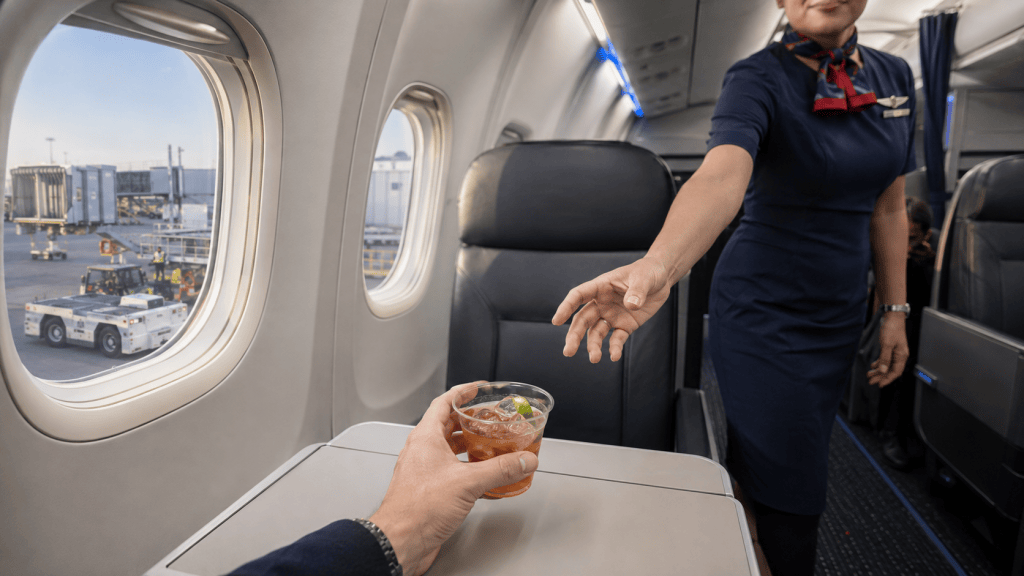
Beginning September 1, Delta flight attendants are being instructed to collect all Delta-provided service items, including those little plastic cups used for pre-departure beverages, before the aircraft pushes back from the gate. Delta says the change is FAA-driven and applies across the airline industry.
So if you’re sitting in first class enjoying a bourbon, wine, Diet Coke or orange juice while everyone finishes boarding, you’d better drink up. Once the airplane is ready to push back, the cup is going away.
And I’m going to say it:
I think this is a little ridiculous.
First, This Isn’t Really a “New FAA Rule”
There’s an important distinction here.
Federal Aviation Regulation 121.577 has actually been around since 1992. It says an airline cannot move an aircraft on the surface, take off or land while food, beverages or tableware furnished by the airline are located at a passenger seat.
So technically, the basic rule is more than three decades old.
What has changed is how the FAA is interpreting and enforcing it.
For years, FAA guidance provided some flexibility involving disposable paper cups and plastic glasses. That is a big reason airlines could provide a pre-departure beverage in first class, begin taxiing, and have flight attendants collect those disposable cups before takeoff.
That flexibility is disappearing. Current FAA guidance is being interpreted to mean that disposable cups need to be collected before surface movement begins as well.
In other words, this is less “the FAA created a new rule” and more “the FAA has decided it is finally going to enforce the old rule much more literally.”
Thirty-four years later.
Government efficiency at its finest.
I Understand the Safety Argument
Before somebody accuses me of wanting flight attendants walking around pouring margaritas while the airplane lines up on the runway, that’s not what I’m suggesting.
There is a legitimate safety rationale.
When the FAA adopted the rule in 1992, it specifically cited the possibility that food, beverages and service items could interfere with passenger movement during an emergency evacuation. The FAA also wants flight attendants focused on safety while the aircraft is moving rather than performing cabin service.
Fair enough.
Taxiing isn’t risk-free. Ground collisions, runway incursions, sudden braking and emergencies can happen.
But safety rules still have to pass a reasonable proportionality test.
And I’m having trouble believing that a passenger sitting in 2A holding a plastic cup containing six ounces of bourbon and Coke represents a meaningful aviation safety threat.
First-Class Passengers Are Paying for More Than a Bigger Seat
This is where I probably differ from some people.
You’ll inevitably hear something like:
“Why should first class get to keep their drinks when everyone else has to follow the rules?”
Because they paid for first class.
That’s the point.
On a domestic flight, the first-class passenger and the person sitting in 32B are ultimately buying transportation between exactly the same two airports.
We push back together.
We take off together.
We land together.
The airplane does not arrive 20 minutes earlier because you’re sitting in Row 2.
What premium-cabin passengers are paying for are the things that happen around that transportation: more space, better seats, priority treatment, upgraded food, better beverage service and an overall better experience.
And that difference in price isn’t always $50 or $100.
I’ve seen domestic first-class tickets priced hundreds of dollars above economy, and sometimes the difference can approach or exceed $1,000.
If someone voluntarily pays that premium, I think the airline should be allowed to give them something meaningfully different for it.
Otherwise, what’s the argument?
Everyone should receive exactly the same experience?
Fine.
Then everyone can pay the same price too.
Billy Idol Understood First Class
This whole story immediately reminded me of one of my favorite airplane scenes from The Wedding Singer.
Near the end of the movie, Adam Sandler’s character is aboard a flight to Las Vegas, and Billy Idol gets involved in helping him win back Drew Barrymore.
As Idol introduces Sandler over the airplane’s PA, he delivers the perfect line:
“Since we let our first-class passengers do pretty much whatever they want…”
It’s obviously a joke.
But there’s something funny about watching a 1998 movie acknowledge a concept airlines occasionally seem determined to forget in 2026.
Premium passengers pay a premium because they want a premium experience.
I’m not suggesting first-class passengers should actually be allowed to do “pretty much whatever they want.”
But could we maybe let them finish the plastic cup of Chardonnay?
What About the Drink You Brought Onto the Plane?
This part gets interesting.
At first glance, the rule creates what looks like a strange contradiction.
If the airline handed you that cup, it falls directly under the FAA food and beverage service rule.
But what about the coffee, water bottle or insulated tumbler you carried onto the airplane yourself?
FAA guidance addresses that too. Passenger-provided food and beverage containers are treated as carry-on items and are supposed to be properly stowed during surface movement, takeoff and landing.
So technically, this isn’t quite the loophole it initially appears to be.
That actually makes the broader policy more logically consistent than some of the headlines suggest.
But it doesn’t change my larger question:
What measurable safety improvement are we actually getting by taking disposable drinks away before pushback instead of before takeoff?
That’s the part I would like to see answered.
This Could Have Another Consequence
There’s also a practical issue.
Pre-departure beverage service already happens during one of the busiest parts of a flight attendant’s job.
Passengers are boarding. Bags need to be stowed. People are changing seats. Families need help. Pilots are moving in and out of the cockpit. Catering may still be finishing. The boarding door eventually needs to close on time.
Now crews have an even shorter window in which to serve those drinks and then collect every cup before pushback.
Delta’s own communication reportedly tells flight attendants to consider beginning beverage service earlier during boarding because customers will have less time to finish their drinks.
I wouldn’t be surprised if the unintended consequence is simpler:
Fewer pre-departure beverages get served at all.
And if that happens, we’ve chipped away at another small piece of the domestic first-class experience.
My Take
I’m always going to side with legitimate aviation safety.
If the data shows that disposable beverage cups during taxi have caused injuries, blocked evacuations or created a measurable safety problem, show us the data and I’ll reconsider.
But if we’re talking about eliminating a long-standing practice because an almost 35-year-old regulation is suddenly being interpreted as literally as possible, I’m not convinced.
Airlines charge substantial premiums for domestic first class. Passengers paying those fares should receive a substantially better experience.
A pre-departure drink is a very small part of that experience, but that’s exactly the point.
It’s small.
It’s inexpensive.
Passengers appreciate it.
And unless someone can demonstrate a meaningful safety benefit from collecting that plastic cup five or ten minutes earlier, I’m not sure what problem we’re solving.
Somewhere, Billy Idol is disappointed.
And frankly, so am I.
Travel Smart,
Tommy Pags


Leave a Reply