
Robotaxis Are Here. I’m Ready for More.
I recently read a story in The Verge about the growing pushback against robotaxis as companies like Waymo, Zoox and Tesla continue expanding autonomous ride services across the country.
There are concerns about safety. There are concerns about jobs. There are questions about who should regulate them, how quickly they should be allowed to expand and what happens when one of these vehicles inevitably does something strange.
I understand the questions.
But as someone who spends a ridiculous amount of time traveling, getting out of airports and climbing into cars in cities all over the country, I have a slightly different reaction.
I think robotaxis are pretty cool.
Actually, I think they could eventually be one of the best things to happen to ground transportation for travelers in a long time.
The First Time I Saw a Car With Nobody Driving It
The first robotaxi I remember seeing was a Waymo at Phoenix Sky Harbor International Airport.
I walked outside and watched a guy get into a Jaguar.
Except nobody was sitting in the driver’s seat.
That gets your attention.
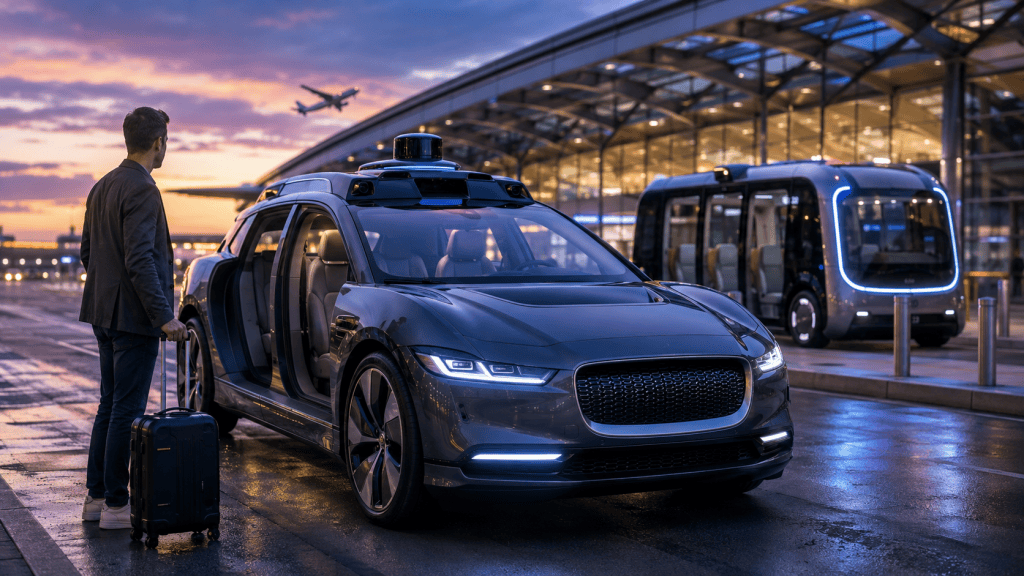
The Waymo vehicles at the time were Jaguar I-PACEs, and they weren’t exactly disguising themselves as regular cars. They had sensors and equipment mounted all over them, so you knew immediately that something was different.
Still, seeing one in person was completely different from seeing a video online.
The door closes.
The car pulls away.
Nobody is driving.
That’s a pretty wild thing to watch for the first time.
And then, on my way to the hotel, I started noticing more of them driving around Phoenix.
It turns out Phoenix wasn’t just some random place where Waymo happened to be testing. Phoenix Sky Harbor became the first airport in the world to offer fully autonomous ride service to and from an airport, and today Waymo pickups and drop-offs are available 24 hours a day at the Terminal 3 and Terminal 4 rideshare areas.
So apparently I wasn’t just watching a technology experiment.
I was looking at what airport transportation may eventually look like everywhere.
Then They Started Following Me Around
After Phoenix, I started seeing Waymos in Los Angeles.
Today, anyone can use Waymo in its Los Angeles service area, which stretches through areas including Santa Monica, Hollywood, Echo Park and Inglewood. One important travel note: Waymo still does not currently serve LAX.
Then I started seeing autonomous vehicles in Las Vegas.
And Vegas takes this to another level.
Some of the vehicles there barely look like cars.
Those are Zoox robotaxis, and if you have seen one, you know exactly what I mean. They look a little like someone took a futuristic van, removed the front, removed the back and then decided nobody really needed a steering wheel anyway.
That’s actually pretty close to what Zoox did.
The vehicle was designed from the beginning as an autonomous robotaxi. It is bidirectional, meaning there isn’t a traditional front or rear. There is no steering wheel or pedals, and passengers sit facing each other inside.
Zoox launched public robotaxi service in Las Vegas in September 2025, initially serving destinations including Resorts World, AREA15 and Topgolf. The company has since expanded to a majority of the major hotels on the Strip, along with other attractions and venues. Resorts World even has a dedicated Zoox pickup and drop-off area through an official partnership with the company.
So when I thought I was seeing robotaxis tied directly into certain Vegas hotels, that’s exactly what was happening.
And from a travel perspective, that’s where this starts getting really interesting.
Are Robotaxis Actually Safe?
This is usually where the conversation goes.
“But what about the accidents?”
Fair question.
A year or so ago, I remember reading some of Waymo’s safety information and being surprised by how few serious accidents there were compared with the number of miles the vehicles were driving.
But we don’t have to take Waymo’s word for it anymore.
In July 2026, the Insurance Institute for Highway Safety released an analysis comparing Waymo’s driverless vehicles with human drivers in the same areas and during the same years.
The result?
Waymo’s driverless vehicles had a 68 percent lower rate of police-reportable crashes than human drivers.
They also had an 81 percent lower rate of injury crashes per mile traveled.
That doesn’t mean autonomous vehicles are perfect.
Nothing involving thousands of pounds of metal traveling down a public road is ever going to be completely risk-free.
But we sometimes seem to hold autonomous vehicles to a standard that human drivers couldn’t survive for five minutes.
A robotaxi has an accident and it becomes a story.
A human driver rear-ends somebody because he was looking at his phone, somebody changes lanes without looking, somebody runs a red light or somebody makes a terrible decision at an intersection, and we basically shrug.
That’s just traffic.
Maybe we should be comparing the two using the same standard.
And Yes, Sometimes the Robot Does Something Stupid
There have absolutely been problems.
In 2026, Waymo recalled software after some of its vehicles entered active freeway construction zones in Phoenix and the San Francisco Bay Area when they should not have. The company changed its software and operating procedures in response.
There have also been plenty of stories and videos over the years showing autonomous vehicles stopping somewhere strange, getting confused or struggling with an unusual situation.
Those things need to be taken seriously.
But occasionally getting confused isn’t exactly an exclusively robotic problem.
Heck, my mom gets lost everywhere she goes.
The question shouldn’t be whether an autonomous vehicle will ever make a mistake.
Of course it will.
The question should be whether, over millions and eventually billions of miles, autonomous vehicles make fewer dangerous mistakes than we do.
So far, at least with Waymo, the data is increasingly pointing in that direction.
There Is Something Else I’ve Noticed
When I’m driving near autonomous vehicles, I’ve noticed something interesting.
People stay away from them.
Maybe it’s curiosity. Maybe it’s uncertainty. Maybe nobody wants to become the guy who hit the driverless Jaguar.
Whatever the reason, I regularly see human drivers give these things a little extra room.
And as a passenger, I’m perfectly fine with that.
If I’m headed to the airport, having everybody on the highway suddenly decide they don’t want to tailgate my car sounds like a feature, not a problem.
I’ve also noticed that autonomous vehicles don’t drive with the same emotional baggage humans sometimes bring to the road.
They’re not late for work.
They’re not angry.
They’re not texting.
They’re not trying to teach the guy in the left lane a lesson.
They’re not tired from a red-eye flight.
And when the system determines it’s time to go, it goes. There isn’t another human driver sitting there wondering if the person across the intersection is going to go first.
There is something very appealing about removing ego, distraction and impatience from driving.
Airports Might Be Where Robotaxis Make the Most Sense
This is the part that excites me most as a traveler.
Imagine landing at an airport, collecting your bag, opening an app and having an autonomous car ready to take you directly to your hotel.
No taxi line.
No wondering where your rideshare driver actually is while the app insists he’s “arriving” even though he’s apparently doing laps around Terminal B.
No phone call asking, “What door are you at?”
No driver canceling the ride.
Just a fleet of vehicles constantly cycling between the airport, hotels, convention centers and other major destinations.
Phoenix already offers a real-world version of exactly that.
And Las Vegas seems almost designed for it. You have enormous numbers of visitors traveling between an airport, a concentrated group of hotels, restaurants, convention centers and entertainment venues. Zoox is already expanding among major Strip properties and has been testing around Harry Reid International Airport in preparation for potential future service there.
For frequent travelers, that could become incredibly convenient.
I Understand Some of the Pushback
The concerns surrounding robotaxis aren’t entirely irrational.
The Verge story points to battles over local regulation, emergency-response issues, safety standards and the very real concern among professional drivers that autonomous vehicles could eventually eliminate jobs. Those are legitimate policy questions, and cities shouldn’t simply hand the streets over to technology companies without rules or accountability.
But those questions are different from saying the technology itself shouldn’t move forward.
We’ve done this before.
Every major transportation technology changed jobs, changed regulations and forced cities to rethink infrastructure.
The answer wasn’t to stop airplanes, automobiles or ridesharing from existing.
It was to figure out how to incorporate them safely.
Robotaxis should be treated the same way.
Bring On the Robotaxi
I’m not pretending autonomous vehicles are perfect.
I’m also not particularly interested in getting into a car controlled by some experimental system that hasn’t demonstrated it can safely handle the real world.
But that’s becoming less and less what we’re talking about.
Waymo alone has now accumulated hundreds of millions of autonomous miles, while independent safety researchers are beginning to find substantially lower crash rates than comparable human drivers. Zoox is putting purpose-built vehicles on the streets that don’t even bother pretending a human might eventually take the wheel.
This isn’t science fiction anymore.
It’s transportation.
And from where I sit, usually somewhere between an airport and a hotel, I’m ready for more of it.
If you can get me from baggage claim to my hotel safely, efficiently and without making me explain for the third time which terminal door I’m standing outside…
I really don’t care whether anybody is sitting in the driver’s seat.
Travel smart,
Tommy Pags.


Leave a Reply