
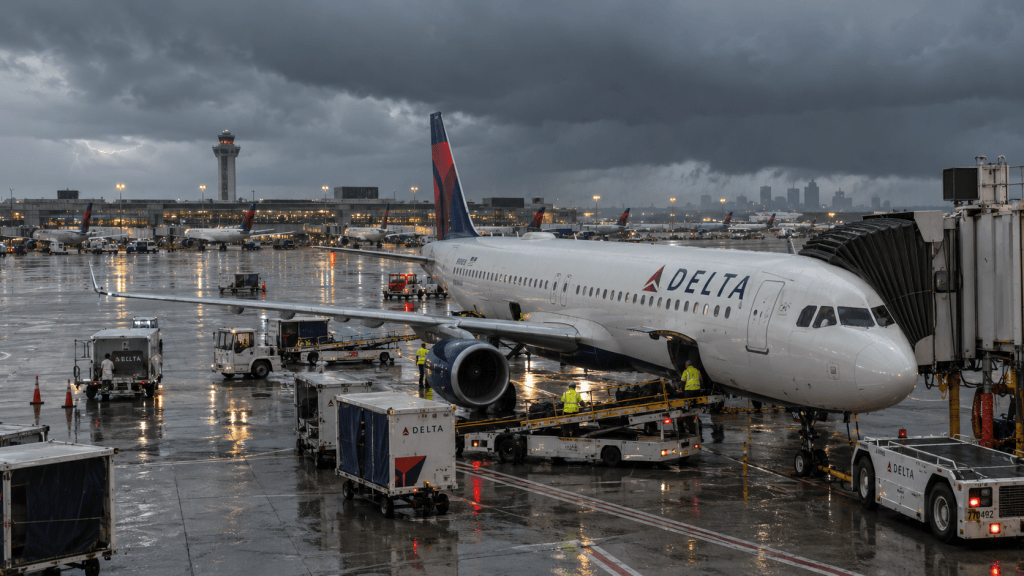
Delta’s Atlanta Trouble Continues: What Travelers Need to Know After Back-to-Back Disruptions
If you were flying Delta through Atlanta this weekend and your itinerary suddenly started looking more like a suggestion than an actual schedule, there was a reason.
Hartsfield-Jackson Atlanta International Airport was hit with significant flight disruptions on back-to-back days, and because Atlanta isn’t just another airport for Delta, problems there have a habit of spreading very quickly.
The headlines have already started calling it another Delta “meltdown.”
I wouldn’t go quite that far.
But if you were one of the passengers staring at a delayed flight, watching your connection time disappear or refreshing the Delta app every five minutes, the terminology probably didn’t matter much.
What Actually Happened in Atlanta?
The trouble really picked up Friday, September 11.
Thunderstorms around Atlanta forced the FAA to impose a ground stop at Hartsfield-Jackson, temporarily restricting aircraft from departing other airports for Atlanta. That is one of the tools air traffic controllers use when an airport simply cannot safely accept the normal flow of incoming aircraft.
Then Saturday brought more of the same weather problems.
The National Weather Service was forecasting scattered to numerous thunderstorms across the Atlanta area, including the possibility of gusty winds, lightning and locally heavy rainfall.
By Saturday, one flight-tracking snapshot showed approximately 335 delays at ATL along with several cancellations. Atlanta was among the most disrupted airports in the country.
And when Atlanta has a bad day, Delta tends to have a bad day.
Atlanta Is the Center of Delta’s Universe
Here’s the part that occasional travelers may not realize.
Atlanta isn’t simply one of Delta’s hubs. It is the center of an enormous portion of Delta’s domestic network.
Hundreds of Delta aircraft and thousands of passengers move through ATL in carefully timed waves every day.
A plane comes into Atlanta from Orlando, for example, then heads to New York. Another arrives from Nashville and continues to Boston. Crews are connecting. Aircraft are changing gates. Passengers are connecting from one flight to another.
Everything is interconnected.
Now throw thunderstorms into that system.
Flights headed toward Atlanta start getting held at their departure airports. Aircraft already in Atlanta can’t leave. Crews begin getting out of position. Incoming passengers miss connections.
Then the aircraft that was supposed to operate your 7:00 p.m. flight isn’t where it is supposed to be.
Congratulations. You have just met the airline industry’s least enjoyable domino game.
Weather May Start the Problem, But Recovery Is What Travelers Notice
This is where I think the conversation gets more interesting.
Nobody reasonably expects Delta, United, American or any airline to fly airplanes through unsafe thunderstorms just to protect an on-time statistic.
Weather happens.
The real test is how quickly an airline recovers after the weather moves away.
That’s becoming increasingly important because modern airline schedules are incredibly complex. Once airplanes and crews are scattered around the country, putting everything back together can take hours.
Sometimes the original thunderstorm is long gone while passengers are still experiencing delays from it six or eight hours later.
That’s why you’ll occasionally look outside the terminal window, see blue skies and think:
“What weather?”
The weather that delayed your airplane might be 500 miles away, or it might have happened several hours earlier.
My Two Cents
This is also why I don’t love immediately calling every major day of airline delays a “meltdown.”
A true operational meltdown is something different.
Think Southwest during Christmas 2022 or Delta following the CrowdStrike outage in July 2024. Those were multi-day failures where the airline’s ability to recover became part of the problem.
Atlanta this weekend certainly had serious disruption, but the evidence points first to thunderstorms and FAA traffic restrictions, followed by the cascading operational consequences.
That’s still miserable if you’re the traveler.
But understanding the difference matters.
It also helps you make better decisions when things start going sideways.
What I Do When My Flight Starts Getting Delayed
If you’re connecting through a major hub such as Atlanta and you see thunderstorms developing, don’t wait until your flight officially cancels before paying attention.
Start watching three things.
First, watch your inbound aircraft.
Knowing where your airplane actually is can tell you much more than the departure board. If your 6:00 p.m. flight says “on time,” but the airplane operating it is still sitting in Atlanta at 5:15 p.m., you already know how this story ends.
Second, watch your connection.
If a delay turns your comfortable 90-minute Atlanta connection into 25 minutes, start looking at alternatives before everyone else on the airplane does.
Third, use the airline app early.
Once a cancellation hits hundreds of passengers simultaneously, available seats disappear quickly. The traveler who starts looking at options while everyone else is waiting at the gate often has a significant advantage.
And Remember Your Refund Rights
There is another distinction travelers should understand.
If an airline cancels your flight and you decide not to travel, federal rules generally require the airline to refund the ticket rather than force you to accept an airline credit.
That doesn’t necessarily mean the airline owes you a hotel, meals or compensation when thunderstorms caused the cancellation.
Weather and airline-controlled disruptions are treated differently.
But if the airline cancels the transportation you purchased and you choose not to take an alternative flight, don’t automatically assume an eCredit is your only option.
The Bigger Lesson
Atlanta is an incredible aviation machine when everything is operating normally.
But that efficiency also means interruptions can spread quickly.
For Delta passengers, especially those traveling through ATL during thunderstorm season, the lesson isn’t necessarily “avoid Atlanta.”
Sometimes that’s impossible anyway.
Instead, build a little breathing room into your itinerary, pay attention to the weather, track your inbound aircraft and don’t wait until the gate agent announces a cancellation before you start considering Plan B.
Because once several hundred flights get delayed at a hub the size of Atlanta, you’re no longer competing against the weather.
You’re competing against thousands of other travelers looking for the same handful of empty seats.
And that’s when knowing what to do can make the difference between getting home tonight and spending an unexpected evening getting acquainted with the airport carpet.
Travel smart,
Tommy Pags
 Pags on the Go
Leave a comment